Labels
Chinese culture
(16)
art
(18)
book reviews
(34)
child abuse
(10)
culture comparison
(10)
ethics
(11)
go game
(2)
history
(19)
life
(76)
love
(12)
movie reviews
(20)
my aphorisms
(97)
philosophy/reason
(13)
quotes
(42)
random thoughts
(146)
religion
(17)
suicide
(3)
September 21, 2011
Knowledge
Labels:
my aphorisms
September 15, 2011
Knowledge - Quote from Plato
"Sure, I said, knowledge is the food of the soul;...there is far greater peril in buying knowledge than in buying meat and drink..."
---Plato, Protagoras
Labels:
quotes
A Gift to Myself
Just got the 3 volume novel War and Peace from Amazon! What at beautiful treasure I ever had! I especially like the "3 volume" part, because when I read Les Miserable it was over 1400 pages in one volume and it felt great inconvenience to hold it, especially for a slow reader like me.It will take me long to finish it, but I expect a good time reading ahead.
Labels:
random event
September 11, 2011
Hardest Things to Accept for Mediocre People
The hardest things for mediocre people (are they majority?) to accept is, 1: the extraordinary of others: the extraordinary talent and the extraordinary tragedy. The reason for the former is jealousy, the latter is selfishness; 2, the ordinary of themselves - the reason is lack of self-confidence.
Labels:
random thoughts
September 7, 2011
Who Is Liu Xiaobo? --- My View on A True Humanist
Upon the time Liu Xiaobo won his Noble Peace Price last year, I knew nothing about him and his works. Due to my indifference towards politics, I also never had enough interest to get into know him as well, until I read his book Mist of Metaphysics (briefed as “Mist" below).
Lu Xun said "It's better to read Chinese books as less as possible. Actually it's better not to read them at all" (he used “books" as a general term, but I believe he specifically meant those books of moral teachings, which pretty much includes all traditional Chinese books). I happened to be such a person who doesn’t read many Chinese books, not because of Lu Xun said so, but simply because they never inspired me that much. But Liu Xiao Bo’s Mist is an exception - it was one of the best philosophy books I have ever read. And by reading it I gained an general impression about the author himself.
The book appears to be a history of western philosophy - it started from ancient Greek thoughts all the way to modern western thinkers. However what make it better than other history books of philosophy (that I have read) is that even though it was written chronologically, the whole book was coherently interwoven so the development of western thoughts were animatedly displayed. This development of western philosophy, under Liu Xiaobo’s interpretation, was a "organic life being", made by the contradictory between the desire of eternal “absolute” and the transitory reality. The whole history is a struggle through a never ending process of the pursuing and overthrowing this “absolute".
Whereas the “appearance” of this book is a history of thinking, it is virtually an highly original work of philosophy, in which Liu input lots of his own thoughts. Briefly speaking, Liu firmly disprove the existence of “absolute truth” (that’s why he called it “mist”), not only in the sense of metaphysics, but in any other sense or forms - such as “God”, "empiricism" or “science”. The whole western metaphysics originated the confidence about human reason, but this confidence is a plain delusion. Any declaration of "absolute" is self deceit, any faith on "absolute" is biased and subjective. From this perspective, art (especially music), by its most direct and essential way, is the only mean that human can experience life.
My impression of Liu Xiaobo from this book is that he is a highly intelligent, yet highly passionate person. He seemed to be greatly influenced by western modern philosophy, especially Existentialism, include modern literature and art. His grasp of the whole development of western thoughts is very impressive, and the points he made for different thinkers and philosophical schools seem to be spot on, and the way he put all these elements together was very inspiring, surpassed most of Chinese “professional” scholars ("pedants"?). So far I conclude Liu Xiaobo as a person contains three aspects: an absolutely independent thinker; an counter-rationalist and a pessimist.
First of all, Liu Xiaobo is an individual thinker. Just by this reason alone, he (or any independent thinkers) is a absolute rebel of his own culture (Chinese tradition). This is because any independent thinkers (a rational being) will not accept any orthodox ideas without personal examination, and this is due to a simple fact that “doubt” is the most essential aspect of reason. Like Liu said in the beginning of the book: “The history of thoughts is the history of questioning”(Mist, Introductory). Unfortunately, this "doubting spirit", is exactly what Chinese traditional ideology/thoughts repel - Chinese traditional ideology is all about “authority”.
As an independent thinker, Liu also gave out his definition of Human being - the ultimate subject of philosophy: “(human) life is first a sentient and animated system, second, it is a (self) consciousness of this system (reason).”(Liu Xiaobo‘s essay: About Reason) I personally absolute admire this interpretation. To me it is to say, only those who strongly possess both “sentience” and “reason” can have a real experience life and a clear conscious of it at the same time. Based on this understanding, Liu highly adores Kant - who was a combination of acute intuition and profound reason, and on the other hand, Liu despises Hegel - who lacked this sentient/animated system totally, and built his whole theory as a grandiloquent decoration over a lifeless body.
And from this understanding about life, Liu naturally criticized “Chinese people” on this very essential level: “if one’s sensation were oppressed totally (servility) , one cannot have rational spirit (reason). If one had, it would be a kind which is nothing more than a blind obedience…the “reason” that Chinese people possess is just a blindly obedience to Chinese traditional orthodoxy” (Liu Xiaobo‘s essay: “About Reason”).
Liu Xiaobo’s “attacks” to Chinese culture is thorough, non negotiable. He thinks during Chinese ancient history there were never anything called “knowledge” existed: “There were never any independent classes - such as Intellects or vendors - existed in ancient China. During the entire Chinese history, only two classes ever existed: rulers and the ruled.” (Mist, page 41) And I personally believe this is the same place that Liu stands on together with Lu Xun, who slashed Chinese culture by his literature works. From philosophical perspective, Liu might be a step further on the rational thoughts, but both are determined, and powerful.
Just like Lu Xun, Liu is a total individualist. He said:"I believe, one’s most valuable moment of life is not to declare to the world as such: ‘I am reprehensive of human', but as this: ‘I am a only one in the world. I do not represent anyone else but myself.’”(Mist, page322) (Here I could clear see the influence of Existentialism).
And just because Liu is not only a "rational being", but also a passionate and sentiment "life form", he is well aware of the limitation of our reason and stepped out of “absolute rationalism” firmly. He doesn’t believe that our reason can bring us to the “absolute truth” (simply it doesn‘t exist). He believes one can only achieve the full meaning of life by experiencing life “itself“ - that is to say through our animated instinct, or through ART: “Irrational state is not a state of animal. The higher level of irrational state is the life in its full bloom. Without this state there is no creativity. ... Life starts with music and ends with music.” (Mist, page51)
Liu’s thoughts resonates the anti-rationalist trend in modern western philosophy. In this book, he compared philosophy with art, said if we call the modern western art “pure art” because of it anti-rationalist tendency, we should as well call the modern western philosophy “pure philosophy”.
This anti-rational tendency made Liu Xiaobo somehow a little “religious”. Of course, he would not blindly accept any religion doctrines due to his rational mind, but he certainly has his insight on religion. He thinks religion is our instinct needs: “human, as a self conscious life, not only need to be satisfied with our current life, but also the next life (or eternal life)… to some extent, the victory of science over religions since Renaissance is just an illusion. In terms of the value of human being, religion is not seconded by science. Believing that science is omnipotent is a new religion. …” (Mist, page27)
Beside these two aspects I mentioned above (independent thinker and anti-rational tendency), Liu Xiaobo also is a pessimist. This is because of his insight on the transient nature of human being. The consciousness of this transient nature leads human to transcends, and at the same time human also conscious the impossibility of such will, thus tragedy is inevitable: “all creativities human made are for one goal: transcendence. But the limited existence cannot creates any such kinds. To human, the so call “transcendence”, only exists in will, eagerness and illusion. " (Mist, page 6)
However, this “pessimism” is not in a mundane sense, but in philosophical sense. This is not the kind of attitude of being sad/complaining, but a confrontation to the reality, an embrace to the tragedy of life. This kind of pessimists, do not need any delusion (such as “absolute”, “God”) to satisfy his/her survival need. And from this perspective, I think Liu Xiaobo again shares Lu Xun’s pessimist spirit.
These are my “impression” on Liu Xiaobo based on the book. The book has over 400 pages, briefly covers over 2000 thousands history of western philosophy. Liu wrote it during his early 30s, and it took him less than half year long. It truly was a work of inspiration. In my opinion, Liu Xiaobo deserves to be recognized as a genius thinker.
I do not know what kind of developments Liu Xiaobo made on his thoughts over the course of twenty years after finishing this book, but I know he once said (despite of his passionate and sharp criticism): “I have no enemy“. However this is just what he said from his perspective. From the perspective of the “nation”, the Chinese government, he is the most dangerous enemy they ever had, and that’s why they put him in prison (I just found the currently is the third time. The first time was after 6.4 students movement 1989). I only hope, Liu Xiaobo has not been enduring too much in prison. I also hope, after he is released in future, he would choose not to live in that country, because that piece of lifeless land (or any lifeless land) is not worth any of his sacrifice (or of anyone who loves freedom).
Labels:
book reviews,
Liu Xiaobo,
philosophy/reason
September 1, 2011
The Situation of Contemporary Chinese Intellects - Inside or Outside of Jails
Labels:
random thoughts
August 25, 2011
Two Different Kinds of Moral Standards
The social moral standards are mostly created by human for establishing social stability. These include laws, religion doctrines and common customs (based on traditional ideology). The humanistic standards are discovered by our conscience, which derives from our nature. The former favors more on social needs, the latter more on individual rights.
History of moral system seems to evolve from strict social morality, which forbid individual desires or needs, toward humanistic morality, which embraces more and more individual rights. Examples such as marriage, patriotism, homosexuality, religious, etc. all demonstrated this route.
Labels:
ethics,
random thoughts
August 14, 2011
Quotes from Liu Xiaobo (5)
(From Mist of Metaphysics, Chapter 4: Kant - the Copernicus-like Revolution )
p215
(Kant) Fallacy originated from the pursue of absolute, ultimate or infinite by our reason, and the belief that this is achievable. This is what I said "mist of metaphysics" - the belief that our reason is capable of deciphering nature, unveiling the secret of life, deducing the existence of God, proving immortality of our soul. But all of these "capabilities" are delusional and fallacious. p226
The blind belief on fallacy is harmful, but not all harmful in terms of ethics. It brings infinite, unlimited and valuable hope to limited, transient and meaningless life. This "hope" can be both positive and negative: when it works as only a reference, it is positive; when it works as an absolute, it is negative. From this perspective, the losing "hope" of modern people is not really so hopeless, not really a collapse of everything, but just a destroy of those "absolute" - which worked as the only value of life, as a bound our hope. p226
No matter how dexterity and smart the Hegel's philosophy seems, overall, there's never been any philosophic systems as "obese" as Hegel's, never been any as "radiant" and "grand", and as stupid and pale. It indeed was a sparkling pyramid, but underneath, it didn't hold a seed of any life, but buried a putrid dead body. A tomb is a symbol of dead, no matter how grand it is. The wit of history is such: the true end of metaphysics was not marked by its sharpest opponent Kant, but by its most loyal follower - Hegel. p262
Labels:
Liu Xiaobo,
philosophy/reason,
quotes
August 5, 2011
Van Gogh's Contribution
For many people the evaluation of a painting is all about technique, or the "likeness", or the "philosophy", but all of these were not Van Gogh's concern. In Van Gogh's painting, we do not see the so-called "profound thoughts" or "concepts", we do not see the passive simulation of nature, rather, we see strong colors, impulsive brush strokes, and the imaginations created by such elements. And these elements, by my opinion, are essence of art.
Once in his life Van Gogh tried to learn realistic skill, but he could not stand the boring process of training, so very soon he quit. He was then considered by his teacher Mauve (also his cousin) as having no potential in art. However Van Gogh did not give up art. He told his brother Theo in his letters that he clearly knew what he was doing and what he wanted, and did not need that much "techniques". What he did proved what he said - within 10 years, a very short period of time, he created massive amount of works with distinguished style, which we had never seen before.
There were several Van Gogh's contemporary artists (such as Gauguin and Rousseau) also reached high achievement without strong academic art training, but in my opinions, their realistic skills were all better than Van Gogh. I believe upon that time (late 19th century), Van Gogh was the only person who made such high level of creative art with the LEAST realistic art training.
This is Van Gogh's contribution - he simply destroyed academic tradition of art. He reached the "heart of art" without all those rational "rubbish". Face to face, heart to heart, Van Gogh made love with art by his "naked" communication with the nature. Starting from him, art gradually came back to its original form: emotional expressive, playful and intuitive, other than rational, thoughtful and technical, which had dominated western art tradition for thousands years. Of course, I should not say this change happened by Van Gogh's effort alone, but he certainly made the "loudest" impact on this crucial turn in art history.
August 4, 2011
Memoir at the Foot of Ngong Hill - Isak Dinesen's "Out Of Africa"
Inside this book, Blixen recalled her life in Africa, when she had a farm at foot of Ngong Hills, Kenya. Very differently from the movie, she didn't mention any of her private life. She only had one sentence for her husband, and about Denys Finch Hatton, who was so important in the movie, Blixen only contributed about 40 pages (among whole 370 pages), in which we found no explicit description about they "love affair".
The opening pages about Africa highlands and Ngong Hills are simply brilliant. It's the best part of the book which I could read again and again (it reminds me the opening chapter of "Rebecca"). Soon after finishing "painting" this scenery, Blixen spent majority part of book to write about some native characters, such as her servants,cooks, etc. She also mentioned her white friends, who came to visit her and entertained her lonely time. Among these "entertainment" Denys Finch Hatton was the most important one.
Within about 40 pages, Blixen wrote about her "friendship" with Denys: their amazing Safaris, and their once almost daily amazing activity - flying over Africa Highlands. Even though she did not directly describe the true nature of their relationship, it is not hard for readers to see their intimacy. The death of Denys was plainly described, which shows me how tough Blixen was. She also wrote quite much details about choosing burying place for Denys, at the top of Ngong Hills, as Denys wished. The narration in the end of movie was exactly the same from the book, except the last sentence.
Denys Finch Hatton seemed to be an extraordinary figure. Among all his alleged "fine" qualities I admire his free and adventurous spirit the most. So I feel very happy for him that he was buried in a place that fits his will. He deserved this glorious land.
White people are not the main theme of this book. This book is all about native people. Native Africans seemed to be very fascinating to Blixen. They were so different from Europeans, but Blixen did not judge the differences by European stands (not even polygamy). Not only she respected their customs, but also their intelligence. In the movie, this view towards native was transmitted by Denys, but in book, this is Blixen's own philosophy - she admired native culture, found they had more advantages than Europeans in dealing with nature and life. They are many moving details about her relationship with native people, especially during her "hard time" - when she faced 'bankruptcy" and had to live the place she loved so dearly.
Beside the natives, Blixen's true heroine of this book is African nature. Having been fancying Africa myself for long time, I found the best part of the book are those rich colored delineations of nature: lands, mountains, trees, clouds, sky, animals, and the best of all, the "air". Under her eyes, Africa was impersonated, and interacted with her mind like her confidant (even when she described her relationship with Denys, she used the nature as a metaphor). The book both starts and ends by Ngong Hills, a glorious "noble" mountain which can be seen from Blixen's house. Even though the whole book is not fictional, not chronological, but the real "protagonist"- Africa landscape puts all details together.
Yes, this book was written for Blixen herself, but it was also written for Africa, and for thsoe whoever love Africa and the Nature.
Labels:
book reviews,
isak dinesen,
karen blixen,
out of africa
July 31, 2011
Quote from Liu Xiaobo (4)
If the Crucifixion was the most shocking moment of Christianity, the thoughts of St. Augustine is the most unforgettable thoughts of Dark Age. The misery revealed by these two (persons) has been hunting human being until today. We must admit, this revelation is a brutal braveness, and a cruel awakening. (P116)
Discovering mysteries of nature by science was not only marked by several "natural principles" - in terms of anti-metaphysics - but changing human's belief. However, in modern history, the thinking style of human has not yet got rid of monism, hence scientism created a new God, new "metaphysics" - a rational, scientific myth. To destroy this myth, was the task of modern philosophy. (P124)
In the world there has never been "absolute lightness" and "absolute darkness". "Absolute" is the synonym of "hypocritical". (P124)
Having been broken the bound of religions and metaphysics, what human could do to conquer nature, develop life and get rid of the tragedy of human itself? This is the task of modern philosophy. In other words, a nature without the power of God, an individual without command of authority, how human could define himself? From this perspective, modern philosophy is not about God, nor about Nature, but Human himself. (P127)
There was a phenomenon, consisted of two contradictory attitudes - an objective empirical view toward the nature on one hand, a transcendantal or almost religious attitude toward the world on other hand - would co-exist within a single mind of a single philosopher... Maybe, human could never get rid of this dualism - swing back forth forever in between soberness and mystery. (P127)
Modern "philosophy of life" meant to destroy the rationalism which started from Socrate, Christianity and Hegelianism; "scientific philosophy" meant to destroy the empiricism from Bacon to Newton. So the anti-metaphysics is virtually anti-absolutism in many forms, ideas, "God", reason, experience, or science, whoever goes to absolute, whoever will receive challenge from anti-metaphysics. (P131)
In terms of thinking style, believing all knowledge must come from experience is the same as believing all knowledge must come from God. (P136)
Labels:
Liu Xiaobo,
philosophy/reason,
quotes
July 18, 2011
Jean Valjean - A Gracious Soul Dwells In Darkness
I must state openly that I do not usually enjoy the excessiveness on description, or writing endlessly on small details, so I cannot say this is my favorite book in terms of writing skill (even though I had read 4 Yuguo's other novels when I was in high school and highly enjoy every one of them), but, I must say, the story of this book - or story of Jean Valjean - deserves to be remembered as one of the greatest stories ever created, for the fact that it delves into such a depth of human nature: the greatest misery and greatest happiness a man/woman can ever experience and ever transcend. Also, the story was extremely beautifully done. Yugo indeed was one of greatest poets.
I like how Yugo named each part of the book: Fantine, Cossette, Jean Valjean, etc. Fantine is an icon of misery, Cossette an icon of happiness, Jean Valjean an icon of salvation, . The relationship between Valjean and Cossette is beautifully portrayed: the immense affection from Valjean and the unconditional trust from Cossette, both made the most innocent bound of two souls. Cossette's entering Jean Valjean's life is meant to be a gift from God, an Angel from Heaven. That's why when Valjean faces the "danger" of losing her, he feels the real peril of his life has just come - a peril greater than all of those he experienced before. That's how for the first time in his life Jean Valjean crys by himself.
Jean Valjean endured incredible hardship and injustice, yet he learned to pay back with the unconditional kindness. As the bishop pointed at the early stage of the story, if Valjean could surpass his past, turn himself into a new person who only love, he would be above all of other people. And that's what Jean Valjean turns out: a person who gives out kindness even though he has received and continues to receives injustice from society.
In this book we could see that human society and social system are full of injustice, which is so unfortunately true since so called "civilization" started. This is utmost unfair to people like Jean Valjean. However, it is author's belief that there is a greater justice: the judgement by God, which eventually handle reward or punishment. That's how Valjean never really tried to escape from Javert's chasing (Javert is an icon of unjust society); that's how at the end of book Javert commits suicide; that how Valjean has his final reward: true love from Cossette and Marius.
A friend (Nothingprofound) said this whole book is all about "forgiveness". I agree totally, even though I think Jean Valjean has done nothing that need to be forgiven. What he is punished by law are far away from crime, yet Yugo made him repent all the time because (I think) Yugo wanted to exaggerate the injustice. I don't really "buy" this sense of "sin", or "guilty", however I do appreciate and deeply moved by the sense of LOVE this book conveys: love melts hatred.
I also must state this, even though Jean Valjean constantly lived in repentance, constantly felt undeserved to Cossette's love, endlessly had that strong sense of looking for forgiveness, in my eye, unlike those filthy Thenardiers, his soul was always clean, he deserved every bit of happiness he found, and he was gracious from the very beginning.
I was big fan of Yugo whan I was young. I do not remember what was the reason I did not choose to read this book back then. After all these years, I am glad I finally read it. Les Miserables is legendary, regardless its "visible" flaws, and it is the most gracious "portrait" of the most gracious soul (Jean Valjean), though framed with the darkest color on this earth. Isn't true by this contrast, the "face" of Jean Valjean looks even more radiant?
-------------------------------------------------------------------------------------
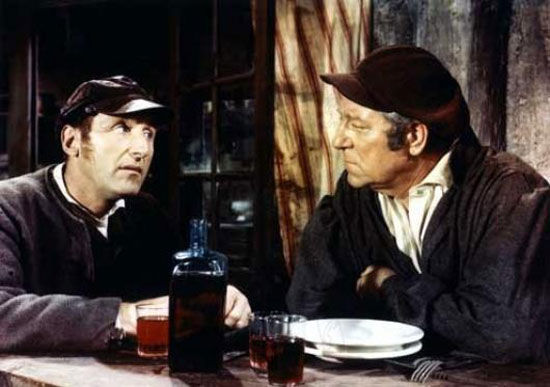
Jean Valjean (Jean Gabin) and Thenardier, 1958 French film directed by Jean-Paul Le Chanois.
P.S. After finishing reading, I watched 3 movies: 1958 French version (which I watched almost 30 years ago but understood/remembered nothing) with Jean Gabin as Jean Valjean; 1998 version with Liam Neeson; 1935 with Fredrich March. I enjoyed the 1958 version the most. Jean Gabin is almsot a perfect Jean Valjean, except his build is a little small. I also enjoy 1935 version, but I think Fredrich looks too polished for Jean Valjean. I cannot stand the 1998 version especially the end: Jean Valjean smiled after Javert died. I don't think Yugo would prove that idea.
Labels:
book reviews,
jean valjean,
les miserables
July 17, 2011
Generality vs. Particularity
Labels:
random thoughts
June 21, 2011
Two Things Are Infinite
"Only two things are infinite, the universe and human stupidity, and I'm not sure about the former."
-- Albert Einstein
Labels:
quotes
June 20, 2011
Quote from "Shawshank Redemption"

When "Andy" plays "Marriage of Figaro", narration by "Red" (Morgan Freeman):
"I have no idea to this day what those two Italian ladies were singing about. Truth is, I don't want to know. Some things are best left unsaid. I'd like to think they were singing about something so beautiful, it can't be expressed in words, and makes your heart ache because of it. I tell you, those voices soared higher and farther than anybody in a gray place dares to dream. It was like some beautiful bird flapped into our drab little cage and made those walls dissolve away, and for the briefest of moments, every last man in Shawshank felt free."
Labels:
quotes
June 15, 2011
Four Attitudes About UNKNOWN
"Who are we? Where do we come from? Where are we going?" After several thousands years of civilization, the question remains as the same as beginning: we still face that mysterious world of UNKNOWN.
Probably, the attitudes (driven by different thinking styles) toward this UNKNOWN divide us in different types of people: rational, irrational, superstitious, skeptical, or something else. Below is what I could think of now about four different attitudes toward this UNKNOWN.
2. To irrationally affirm the "knowledge" of UNKNOWN, to factualize UNKNOWN, to mystify or decorate UNKNOWN as human wishes, is an attitude of religion, or "conventional" superstition;
3. To hold our reason firmly as a solution to everything, to deny the existence of UNKNOWN, or to believe that just because we have known a great deal so we will know everything sooner of later, is an attitude of modern "religion" - worship of science;
4. To absolutely deny any possibilities to reach the truth of "UNKNOWN", to disbelieve completely about science in terms of discovering the truth of universe, is an attitude of agnosticism, which is also irrational, because it kills "HOPE" (or possibility) - the only thing that perhaps will be always "alive" (as long as the Universe exists).
Labels:
random thoughts,
religion
June 14, 2011
Two Conditions That Produce Life Misery
If we agree that being able to be ourselves is the most essential condition of our life happiness, two other conditions will destroy this condition:
This "ambition" is built on illusion - "someones else" are mistaken for "ourselves". The causes of such illusion are multiple and complicated, but I believe a very important cause is false parenting/education.
When we held this "illusion", life is inevitably on the route towards misery, because (at the best account) even if we succeeded this "ambition" at certain level - i.e. we successfully turned out to be "someone else" - we could still not be truly happy because our true nature (or true "selves") will always be hungry at our unconscious level.
The only way to change this condition is "enlightenment" - realizing we are on the wrong track. As soon as we reach this enlightenment, happiness will naturally emerge to our life.
However, the danger of this condition is, if the condition stays too long with us, (also depend on how strong our "true selves" and "other selves" are) we might eventually forgot who we truly are, hence it is almost impossible to get our "true selves" back.
2. Knowing who we are but could not become who we are.
This condition is also created by complicated and multiple factors: false parenting/education, physical diseases, wars, social systems, or ultimately, fate.
I found this is the most commonly struggled condition of life. The ways to cope with such condition are numerous and complicated, and there will never be a single universal solution to this problem, because no one has the completely same life course as others, . However, to simplify the tanglement I would say there are two major pathways to get out of trap: fight and acceptance*.
If there is one thing worth fighting for in this world, it would be "happiness". However sometime the "enemy" can be some unconquerable monsters, such as powerful side of our relationship, or powerful social classes, or even "fate"; sometime the fighters -"we" - can be too fragile to fight, either mentally or physically, such as individuals against groups, fatal diseases, etc. In such cases, negotiation, or acceptance need to take place.
So after all, I think wisdom lies in the balance between "fighting" and "acceptance" - those who know when to fight and when to negotiate will eventually win the happiness, no matter what condition is.
However, since happiness is worth fighting for, I would say:
(If we really know what we want) Never negotiate without a fight.
*I have used "negotiation" and "acceptance alternatively, but I do know they do not have identical definition. The difference between them would be a relatively serious topic in which I do not wish to evolve.
Labels:
random thoughts
June 13, 2011
Ellen Degeneres - A True Genius of Love
If people asked me who was my favorite actors or actress, I might not have an immediate answer, but if people asked am who was my favorite comedian, my answer would be straight and simple: Ellen Degeneres.
I was so impressed by her early stand up shows (I even ran for a live one in Northampton, Mass). All her early stand up shows were incredibly hilarious and philosophic! Reminding me lot of Taoist ideas about life. She was the first American person (I know of) I consider as a Taoist.
The first stand up show I watched was "New Beginning" - the show she performed on her first tour after she came out from her "down time" (her hollywood career was destroyed by her coming out in 90s). I watched this show on VHS type. Now it's on youtube:
It is a true inspiring piece about life.
Later, her new stand up show "Here and Now" came out:
"Here and Now" is all about the "boring" "procrastination", but by my opinion this is a true masterpiece of Taoism about time and life. I highly recommand who ever interested in Taoism and Ellen as a genius thinker (she actually only had high school diploma) watch these brilliant comedy stand up. You will not be disappointed!
I was so impressed by her early stand up shows (I even ran for a live one in Northampton, Mass). All her early stand up shows were incredibly hilarious and philosophic! Reminding me lot of Taoist ideas about life. She was the first American person (I know of) I consider as a Taoist.
The first stand up show I watched was "New Beginning" - the show she performed on her first tour after she came out from her "down time" (her hollywood career was destroyed by her coming out in 90s). I watched this show on VHS type. Now it's on youtube:
Later, her new stand up show "Here and Now" came out:
"Here and Now" is all about the "boring" "procrastination", but by my opinion this is a true masterpiece of Taoism about time and life. I highly recommand who ever interested in Taoism and Ellen as a genius thinker (she actually only had high school diploma) watch these brilliant comedy stand up. You will not be disappointed!
Labels:
Ellen degeneres,
life,
philosophy/reason
June 11, 2011
Quotes from "Les Miserables"
Innocence wears its own crown, Monsieur; it needs no added dignity; it is as sublime in rags as in royal robes. p54
...since natures vary, we must agree that all the beauties of human excellence may be fostered by faiths that we do not share. p65
What more could he need, this old man whose little leisure was divided between daytime gardening and night-time contemplation? Was not that narrow space with the sky its ceiling room enough for worship God in the most delicate of His works and in the most sublime? A garden to walk in and immensity to dream in - what more could be ask? A few flowers at his feet and above him the stars. p68
Man is so constituted that he can endure long periods of suffering, both moral and physical, without dying of it. p96
There is a prospect greater than the sea, and it is the sky; there is a prospect greater than sky, and it is the human soul. p208
Labels:
quotes
June 10, 2011
Spiritual Reality - Journey Within
A friend of mine sent me this video presentation about Buddhist concepts such as Meditation, Knowledge, Energy, Consciousness, Life and Death, etc.
Not sure how superstitious you would find, I found it both inspiring and superstitious. Several interesting quotes from video:
Sleep is an unconscious meditation; meditation is conscious sleep;
Meditation is nothing but a journey of our Consciousness toward "self";
Knowledge is nothing but experience;
Consciousness is a combination of Energy and Knowledge.
Knowledge is nothing but experience;
Consciousness is a combination of Energy and Knowledge.
Labels:
quotes
Subscribe to:
Posts (Atom)