Labels
Chinese culture
(16)
art
(18)
book reviews
(34)
child abuse
(10)
culture comparison
(10)
ethics
(11)
go game
(2)
history
(19)
life
(76)
love
(12)
movie reviews
(20)
my aphorisms
(97)
philosophy/reason
(13)
quotes
(42)
random thoughts
(146)
religion
(17)
suicide
(3)
June 29, 2012
"A Short History of The World"
I like history and always wanted to read a book that could give me a clear view of the world history in a relatively small scale. I had very difficult time to find one until I read this one (it is in kindle only). It was written in simply English - which I especially appreciate, and was definitely clear, with most crucial invents of history displayed distinctively, yet interactively. And the author's view points on each events are not only unbiased, but also touch very profound understanding on human nature. I have to say, it is this book (kindle) that gave me a holistic view on world history, and made me feel that I finally crossed the threshold of this knowledge.
I highly recommend. $7.99 price is much more than just well spent!
Labels:
Amazon.com,
book reviews,
history,
World History
June 27, 2012
10 Books That Inspired (First Half of) My Life
| Victor Hugo, by Alphonse Legros. (Photo credit: Wikipedia) |
I read a lot when I was young. Since I came to this country (USA), immigration life did have tones of challenge, which made me had little time and mood for reading. Now, at middle age of my life, looking back, I found it's necessary to write down some books that influenced me the most. This also can be a brief summary of my thoughts of life. Below are 10 books I could think of, roughly chronological, with brief description of how they affected my thoughts (not a brief book - review):
1. John Christopher (Roman Rolland) - to appreciate the richness of one's inner universe. I was in my teenage time when I read this book. The inner waves of youth echoed with every page of this epic life story.
2. The Man Who Laughs (Victor Hugo) - love is blind. As a master of passion, Hugo's depiction of human desire is both powerful and exquisite. Had the female character (Dea) not been blind, would she still love Gwynplaine - a man whose face was disfigured? We don't know. However, Hugo's careful design, the love story between a girl with blind eyes and a man with hideous face really "explains" the blindness of human love.
3. Crime and Punishment (Dostoevsky) - "God"'s mightiest love is his unconditional forgiveness toward human sin. I wouldn't understand this as lots of Christians believe, that the only way to get into "heaven" is to believe in Jesus Christ, instead, I understand this as such: we must forgive ourselves and others, do not let the mistakes (or sin) of our past to block the light of today and future.
4. Dear Theo (Van Gogh) - a solo narrative of a lonely soul. Within his long term correspondence with his brother, Van Gogh recorded his thoughts of daily life, which shows his intimacy with nature, and estranged relationship to human world. Again, this type of solitary lifestyle seemed to echo with something inside me, when I was in my late teenage time.
5. Beethoven (Roman Rolland) - the loneliness of a genius. Like Victor Hugo, Roman Rolland was also a master of passion. In this short biography of Beethoven, Rolland focused on the loneliness and valor of the music prodigy. This book, maybe together with John Christopher, made me realized (in a relatively early age of my life), that the loneliness of a few geniuses - contrary to the comfort of majority - seemed to be a natural phenomenon in human world.
6. Siddhartha (Hermann Hesse) - the ultimate enlightenment of humans is in the process of, and eventually accomplished by "conversation" between humans and the nature. I was once highly interested in Buddhism, however, none of Buddhism teaching books taught me the spirit of Buddha as much as this short story by Hesse. I also realized, that the communication between humans and the nature existed in all humans cultures, not only in oriental philosophy, such as Buddhism or Taoism.
7. Escape from Freedom (Eric Fromm) - lost of humans crimes are stemmed from the weakness of human nature - not the physical weakness but the (mental) fear of being alone, or the isolation (of individuals) from groups. In terms of understanding human nature, I found none of other books influenced me as deep as this book. It seems, that after reading this book, all my life experience and observation became evidence to his theory (I hope this doesn't prove that my thought distorted my observation. No, I don't think so).
8. The Art of Love (Eric Fromm): true love is not an unconditional possess of another person, but an unconditional acceptance of another person. If Hugo displayed what is love in literature (art) form, Fromm analysed "love" by reason (sounds impossible!).
9. Les Miserable (Hugo) - forgiveness is the highest form of love. I loved Hugo's works since I was a teenager, however, this epic story came to me decades later, and still, it shocked my heart like his other works did to me when I was young. Regarding what is "forgiveness", I simply think Hugo did the best humans could.
10. Rebecca (Daphne Du Maurier) - life, is the ultimate mystery. The reason I put this book at the end is not because I read this book most recently (I read this book over 20 years ago), but simply because it truly is my favorite of favorites. By a simple story of love and death, the book takes readers into the psychological journey of protagonist, who from a "Cinderella" becomes a confident mistress of a grand estate. The beautiful & smooth writing style, wit and sense of humor, both natural developed story-line and "casual" swaying between present and past, all these "perfections" made this book becoming to my favorite literature work that I could read again and again, even thought it is not one of the best known works among English classical literature.
Reading is a way to gain knowledge, also a great pleasure to communicate vicariously with a broader world. Listing these books is not to say that I would not reach to the same understanding without reading them, because I believe, anyone can reaches his/her own wisdom with or without reading lots of books, because (needless to mention) the #1 best book for us to gain "knowledge" and enjoy life, is indeed life itself.
But still, I am glad that I read these books, and many others, and will read more when life permits me to.
Labels:
book reviews,
life
"Thanksgiving" in China
A social activities named as "bathing feet for parents" (or "bathing parents' feet?) seems to be quite active in China here and there, during recent years. The "spirit" of such activities is "thanksgiving to parents". This picture shows somewhere in China over 300 hundred middle school students washing (or bathing ) their parents' feet. Of course, such event would doubtlessly occupy the title page of major news media, such as "People's Daily News" in China, and gain wholehearted support of majority of Chinese population.
The event in the picture happened sometime in May of this year, but I did heard such thing happened several years ago, when I wrote a critical post in my Chinese blog.
As I always understand that the only true "religion" in China is ancestor worship, to revere parents also can be one of such "religious" practice. Of course, Mao once destroyed such tradition, which led China went another "extreme", but now, such tradition revived, even though the political environment is still "communism" (I always believe it is ideologies, not politics decide collective behaviors or actions).
I guess, China will have a long way to go before she understands that parents, the ones who produce kids simply by having sex - an animalistic function, were not the revered one who gives us life.
Labels:
china,
random thoughts
June 26, 2012
Mental Toughness
| Maria Sharapova @ Roland Garros (Photo credit: johanlb) |
Labels:
my aphorisms
June 24, 2012
Superstition vs. Science
Lots of superstitions in the past have been turned out to be true (or "true" depend how we look at them) by scientific studies, lots of "scientific truth" in modern days are turning into superstitions by faith in "science".
Labels:
random thoughts
June 23, 2012
Confidence
Confidence, is something more to do with how much we enjoyed our life, than how much achievements we accomplished.
Labels:
my aphorisms
June 21, 2012
"One Child Policy" - The Worst Curse Happened to China?
(Just read an article "One child policy is the worst curse happen to China" in a Chinese forum. Haven't read the article but the title did ring the bell, triggered me writing down the following words):
For most outsiders, "1 child policy" might be one of most notorious human right violations made by Chinese government. I agree, the practice of this policy is inhumane. However, the other side of story is, the policy alone, really was pushed by the uncontrollable population explosion since new China was born 1949. It was a right move by my opinion, because otherwise, things would go beyond control.
Here is what happened earlier: In 1949, the demographic data shows Chinese population was less than 0.5 billion; in 1979, 30 years later, when "1 child policy" was made by government, the population increased to about 1 billion (http://www.populstat.info/Asia/chinac.htm). And I heard (also believe) that the factual number was over 1.2 billions. The reason the population increased this much was mainly due to the policy made by Mao himself which encouraged all mothers to be "heroine mother" - which means having as many children as possible. Echoing with Chinese tradition that focused on the continuation of family blood ties, Chinese people cooperated with the policy with great passion. Of course, there were other reasons too, such as political belief - more people makes China stronger, fighting with capitalism, etc. The overwhelmingly ignorance of none-educated Chinese people made government easier to manipulate them (of course, this doesn't say that "educated ones" knew better). So, during "heroine mother" time, many women were constantly under pregnancy, and some families had as many as more than 10 kids. That's how Chinese population increased nearly 3 times more during only 30 years, despite of the fact that "Great Forward Leap" killed over 30 millions people!
This really is stunning. If situation continued, with same rate, another 30 years later, which was 2009, Chinese population would be over 3 billions (right now is 1.4 billions by official report). This number no doubt is something that none of the governments on this earth could handle.
And needless to mention the quality of lives under such density of population would be extremely poor: children do not get basic care, child abuse would certainly gets worse than what it already is (child abuse in China has been extremely underestimated, by both Chinese people and government).
Many outsiders only see the inhumanity of practice of "1 child policy". Yes, it is, but the other side of story is, killing babies, dumping unwanted children have been long existed in a country like China (I am aware of such thing also happen elsewhere, but scale is what made difference here). Children, has been the number one victim of Chinese tradition (mostly Confucianism), and they have been living in a condition that is not only without "love", but also without mercy. Under such circumstance, I do not think "1 child policy" is totally faulty, because it is my understanding that lives without decent care would grow into the worst nightmares. So, I believe when parents are not ready, it is better not to have any children than to have many unwanted children, and to abuse them, to make their lives unbearably painful.
It is true that the practice of "1 child policy" (not necessarily policy itself, bmo) is a crime that violets human right, but on the other hand, the huge population explosion would certainly have a much worse consequence. So, nevertheless, no matter which side to choose, the situation really is the worst curse ever happened to China - once the most beautiful and fertile land that nurtured the largest population on this earth.
Yes, we human take mother nature for granted, here comes the consequence.
For most outsiders, "1 child policy" might be one of most notorious human right violations made by Chinese government. I agree, the practice of this policy is inhumane. However, the other side of story is, the policy alone, really was pushed by the uncontrollable population explosion since new China was born 1949. It was a right move by my opinion, because otherwise, things would go beyond control.
Here is what happened earlier: In 1949, the demographic data shows Chinese population was less than 0.5 billion; in 1979, 30 years later, when "1 child policy" was made by government, the population increased to about 1 billion (http://www.populstat.info/Asia/chinac.htm). And I heard (also believe) that the factual number was over 1.2 billions. The reason the population increased this much was mainly due to the policy made by Mao himself which encouraged all mothers to be "heroine mother" - which means having as many children as possible. Echoing with Chinese tradition that focused on the continuation of family blood ties, Chinese people cooperated with the policy with great passion. Of course, there were other reasons too, such as political belief - more people makes China stronger, fighting with capitalism, etc. The overwhelmingly ignorance of none-educated Chinese people made government easier to manipulate them (of course, this doesn't say that "educated ones" knew better). So, during "heroine mother" time, many women were constantly under pregnancy, and some families had as many as more than 10 kids. That's how Chinese population increased nearly 3 times more during only 30 years, despite of the fact that "Great Forward Leap" killed over 30 millions people!
This really is stunning. If situation continued, with same rate, another 30 years later, which was 2009, Chinese population would be over 3 billions (right now is 1.4 billions by official report). This number no doubt is something that none of the governments on this earth could handle.
And needless to mention the quality of lives under such density of population would be extremely poor: children do not get basic care, child abuse would certainly gets worse than what it already is (child abuse in China has been extremely underestimated, by both Chinese people and government).
Many outsiders only see the inhumanity of practice of "1 child policy". Yes, it is, but the other side of story is, killing babies, dumping unwanted children have been long existed in a country like China (I am aware of such thing also happen elsewhere, but scale is what made difference here). Children, has been the number one victim of Chinese tradition (mostly Confucianism), and they have been living in a condition that is not only without "love", but also without mercy. Under such circumstance, I do not think "1 child policy" is totally faulty, because it is my understanding that lives without decent care would grow into the worst nightmares. So, I believe when parents are not ready, it is better not to have any children than to have many unwanted children, and to abuse them, to make their lives unbearably painful.
It is true that the practice of "1 child policy" (not necessarily policy itself, bmo) is a crime that violets human right, but on the other hand, the huge population explosion would certainly have a much worse consequence. So, nevertheless, no matter which side to choose, the situation really is the worst curse ever happened to China - once the most beautiful and fertile land that nurtured the largest population on this earth.
Yes, we human take mother nature for granted, here comes the consequence.
June 19, 2012
Making Big Money
Waking up this morning, I just realized that making BIG money never be a true life dream to me. It is not that I never thought about it - yes, I thought about making lots of money, many times, mainly during my earlier life when money was pretty much the only thing people talked about, but, (I realized now) whenever I thought about money, I thought about my parents, my sister - people who had high expectation on me. In other words, money as a "life dream", was never belong to my own, but to other people (my family members).
I remember for a very long time I had this "dream" carry on, felt my life was somehow unsuccessful. Even though I did not seriously engage in battles of making big money, but money was still an unconscious "measurement" of my life "success". It was the point that I unloaded my family from my shoulders, I started to feel differently: I can make little income and still be happy.
Indeed I can, because my life dream is freedom, not money. And I succeeded.
I remember for a very long time I had this "dream" carry on, felt my life was somehow unsuccessful. Even though I did not seriously engage in battles of making big money, but money was still an unconscious "measurement" of my life "success". It was the point that I unloaded my family from my shoulders, I started to feel differently: I can make little income and still be happy.
Indeed I can, because my life dream is freedom, not money. And I succeeded.
Labels:
life
June 9, 2012
June 7, 2012
Should We Believe What We See? - How Thoughts Distort Observation
"I am the wisest man alive, for I know one thing, and that is that I know nothing. " --- Socrates
Observation can be considered as the first step of our understanding reality. We may trust our observation without thinking twice because we believe that what we see cannot be false. However, I found otherwise: our observation often is subjective, even far from true. This is because that so often we look at things with biased eyes. In other words, our observation is often controlled by our THOUGHTS, we see only what we want to see, or we unconsciously ignored those evidences that would disprove our thoughts.
Making example of art learning. During perspective practice, many people without previous training would draw the bottom of a cylinder as a straight line (or a curve that is not curved enough), even though what they see is actually a curve (the degree of the curve is depend on angles). Why? I found the answer is rather simply, because they THINK the bottom is flat. This fact demonstrates perfectly how we use our THOUGHTS control our observation: we think the bottom of cylinder is flat, so we should draw a straight line, regardless what we actually see is a curse. (see image on the right)
Another example is how we humans treat homosexuality. Until today, among most people in the world homosexuals are abnormal, which mean it is contradictory to our understanding of human nature, which is: we humans are all born heterosexual. Do we really understand human nature that well? Truth is, homosexuality has been existing along with human being. Scientists even found that homosexual behavior also exists in animal world. These facts are enough to prove that homosexuality is something natural. And what really is "unnatural" or "abnormal" is our thought, or understanding about human nature.
Not only "ordinary" people are often falling such observation - thoughts distortion, but also some geniuses would do the same. Einstein, the person who challenged Newton when he was only 25, refused to accept Quantum theory, a new field of study that Einstein himself helped to establish. The reason Einstein rejected this theory was because it was so obviously contradicts classical physics, also to "common sense". But both theoretical and experimental studies showed that Quantum theory was "neither wrong or incomplete" (Einstein Decoding Universe, Francoise Balibar, Discoveries, 2001). So despite Einstein's rejection, quantum theory had been developed quickly and contributed tremendously to modern technology.
My mentioning this part of Einstein does not mean to say that Einstein was not a genius, only to say that even a genius would have his/her "human limitation" (I know nothing about physics but I would still keep an open mind, that one day, maybe Einstein's doubt on quantum theory would be proven to be right). I also think, that this example also demonstrates that our human reasoning has its limitation: something doesn't fit our common sense, or logical reasoning, doesn't necessarily mean it is not true.
There are many more examples in real life on this "subjective observation". We often hear people saying "I don't get this" or "I can't get that", this usually just means that what we see don't fit our existing understanding. Our "theorems" are highly limited, variation in real life is infinite, using limited "theorems" to measure infinite variation, of course we will often be in dead ends. Had we changed our bad "hobby", look at things not from "thoughts", but from reality itself, things would be much easier for us to understand.
Why we humans are so obsessed with out theories, or thoughts? This surely involves some complicated scientific study about how the "consciousness" evolved, and is certainly beyond my knowledge and capability (or we can simply blame "snake" of Eden, who brought us the "fruit of wisdom"). But what I am more and more convinced is, that we human since obtained consciousness, developed an obsession with it, feeling an extreme satisfaction when exaggerating its potential, and eventually became some sort of "bigotry". Our tradition, ideology, moral standards, all are just some "temporary logic" ("temporary" here can be "decades", "hundred", or more than "thousands" years), but they have been taken by many people, generation to generation, as "absolute", and used as standards to judge reality. In fact, I think it is exactly these "absolutes" that mostly need to be re-thought or re-examined.
If we look back history, it is not hard to realize that almost every step forward we made, was based on overthrowing some existing "absolute": heliocentric took over geocentric theory, evolution challenged divine creation, relative space-time refuted absolute space and time, democracy replace despotism, etc. So I think the most important "rule" we may follow is, whenever we hit the "dead end", instead of throwing judgments, we rethink our thoughts or beliefs. Only if we can doubt our belief, dare to overthrow the premise of our "logic", admit the limitation of human intelligence, we can be credited as "open minded". On the other hand, only if we take our thoughts as relative, as possible faults, we can have acute observation, be able to see some relative truth.
Of course, essentially speaking, our visions are all limited. That's why I believe that human wisdom is measured not by how much we know, but by how much we acknowledge the limitation of our intelligence.
Observation can be considered as the first step of our understanding reality. We may trust our observation without thinking twice because we believe that what we see cannot be false. However, I found otherwise: our observation often is subjective, even far from true. This is because that so often we look at things with biased eyes. In other words, our observation is often controlled by our THOUGHTS, we see only what we want to see, or we unconsciously ignored those evidences that would disprove our thoughts.
Making example of art learning. During perspective practice, many people without previous training would draw the bottom of a cylinder as a straight line (or a curve that is not curved enough), even though what they see is actually a curve (the degree of the curve is depend on angles). Why? I found the answer is rather simply, because they THINK the bottom is flat. This fact demonstrates perfectly how we use our THOUGHTS control our observation: we think the bottom of cylinder is flat, so we should draw a straight line, regardless what we actually see is a curse. (see image on the right)
Another example is how we humans treat homosexuality. Until today, among most people in the world homosexuals are abnormal, which mean it is contradictory to our understanding of human nature, which is: we humans are all born heterosexual. Do we really understand human nature that well? Truth is, homosexuality has been existing along with human being. Scientists even found that homosexual behavior also exists in animal world. These facts are enough to prove that homosexuality is something natural. And what really is "unnatural" or "abnormal" is our thought, or understanding about human nature.
Not only "ordinary" people are often falling such observation - thoughts distortion, but also some geniuses would do the same. Einstein, the person who challenged Newton when he was only 25, refused to accept Quantum theory, a new field of study that Einstein himself helped to establish. The reason Einstein rejected this theory was because it was so obviously contradicts classical physics, also to "common sense". But both theoretical and experimental studies showed that Quantum theory was "neither wrong or incomplete" (Einstein Decoding Universe, Francoise Balibar, Discoveries, 2001). So despite Einstein's rejection, quantum theory had been developed quickly and contributed tremendously to modern technology.
My mentioning this part of Einstein does not mean to say that Einstein was not a genius, only to say that even a genius would have his/her "human limitation" (I know nothing about physics but I would still keep an open mind, that one day, maybe Einstein's doubt on quantum theory would be proven to be right). I also think, that this example also demonstrates that our human reasoning has its limitation: something doesn't fit our common sense, or logical reasoning, doesn't necessarily mean it is not true.
There are many more examples in real life on this "subjective observation". We often hear people saying "I don't get this" or "I can't get that", this usually just means that what we see don't fit our existing understanding. Our "theorems" are highly limited, variation in real life is infinite, using limited "theorems" to measure infinite variation, of course we will often be in dead ends. Had we changed our bad "hobby", look at things not from "thoughts", but from reality itself, things would be much easier for us to understand.
Why we humans are so obsessed with out theories, or thoughts? This surely involves some complicated scientific study about how the "consciousness" evolved, and is certainly beyond my knowledge and capability (or we can simply blame "snake" of Eden, who brought us the "fruit of wisdom"). But what I am more and more convinced is, that we human since obtained consciousness, developed an obsession with it, feeling an extreme satisfaction when exaggerating its potential, and eventually became some sort of "bigotry". Our tradition, ideology, moral standards, all are just some "temporary logic" ("temporary" here can be "decades", "hundred", or more than "thousands" years), but they have been taken by many people, generation to generation, as "absolute", and used as standards to judge reality. In fact, I think it is exactly these "absolutes" that mostly need to be re-thought or re-examined.
If we look back history, it is not hard to realize that almost every step forward we made, was based on overthrowing some existing "absolute": heliocentric took over geocentric theory, evolution challenged divine creation, relative space-time refuted absolute space and time, democracy replace despotism, etc. So I think the most important "rule" we may follow is, whenever we hit the "dead end", instead of throwing judgments, we rethink our thoughts or beliefs. Only if we can doubt our belief, dare to overthrow the premise of our "logic", admit the limitation of human intelligence, we can be credited as "open minded". On the other hand, only if we take our thoughts as relative, as possible faults, we can have acute observation, be able to see some relative truth.
Of course, essentially speaking, our visions are all limited. That's why I believe that human wisdom is measured not by how much we know, but by how much we acknowledge the limitation of our intelligence.
Labels:
philosophy
May 30, 2012
Understanding and Relationship
In order to building a HEALTHY relationship - love relationship or friendship, a complete understanding to each other is not necessary, nor possible (generally speaking), but an understanding (or recognition) of one of the most important human nature - individual differences, is required.
Labels:
random thoughts,
relationship
May 28, 2012
History Quotes
"Europe, on the other hand was a collection of small and competing states with multiple cultures and languages and this unsuspectingly served as an advantage to its inventors and explorers; if one party failed to sponsor them, they could always turn to another. Either way, it was in a country's best interests to keep up with the latest technologies in order to keep the balance of power. As a result inventors were encouraged rather than discouraged.
'In the end it was precisely the instability which Europeans had been trying unsuccessfully to evade for so long which had turned out to be their greatest strength. Their wars, their incessant internal struggles, their religious quarrels, all these had been the unfortunate, but necessary condition, of the intellectual growth which had led them, unlike their Asiatic neighbours, to develop the metaphysical and inquiring attitudes towards nature which, in turn, had given them the power to transform and control the worlds in which they lived'" (Worlds at War, by Anthony Pagden)
---A short history of the world, by christopher Lascelles
'In the end it was precisely the instability which Europeans had been trying unsuccessfully to evade for so long which had turned out to be their greatest strength. Their wars, their incessant internal struggles, their religious quarrels, all these had been the unfortunate, but necessary condition, of the intellectual growth which had led them, unlike their Asiatic neighbours, to develop the metaphysical and inquiring attitudes towards nature which, in turn, had given them the power to transform and control the worlds in which they lived'" (Worlds at War, by Anthony Pagden)
---A short history of the world, by christopher Lascelles
Labels:
history
May 27, 2012
Modern Myth - Mental Unwellness as the Cause of Physical Unwellness
| Chronic Disease (Photo credit: tamahaji) |
Studies show that many people who have mental problems such as depression or anxiety also have physical problems. This result seems to be very convincing about how mental wellness affect physical condition, but for me, it doesn't. I agree it does show the connection - our mental and physical parts of lives closely connect to each others, but, I do not see it shows mental condition IS THE CAUSE and physical illness IS THE CONSEQUENCE. For me, a reversed procedure is much more convincing - that very often mental unwellness is the consequence of our bad physical condition.
By my limited knowledge, the reasons that many people believe mental unwellenss is a cause of our physical health are: 1, modern psychology brought the importance of mental condition to our concern (which is good); 2, many studies show the connections between mental and physical health; 3, the "faith" to modern medicine (in other words, when doctors cannot diagnose a self-claimed physical illness, they blame to patients' mental conditions). But for me, none of these reasons show precisely that mental illness is the CAUSE of our physical illness - modern psychology just stressed the importance of our mental health, it does not necessarily make it as the cause of everything; the connection between mental and physical condition does not prove mental condition is the cause of latter (as I pointed out above), and doctors' failure on diagnosing physical diseases also cannot be a proof of patients' mental problems (rather, it is a proof of the ignorance of many so call "experts:). But why people still easily believe on our mental power? I am not entirely sure, and that's why I call it "modern myth".
One of examples of how people hold such belief is how doctors treat patients with unknown chronic illnesses. Whenever they failed diagnose some diseases by their knowledge and expensive equipment - which they (doctors and many people) believe as "omnipotent" on humans' physical function, they would confidently ask patients: "are you in depression?" And in most case, these patients are unfortunately in depression, at lease when they are very ill. But important fact is, their depression usually is caused by their physical condition, not the another way around:
"we should not confuse the fact that the vast majority of fatigue patients are depressed BECAUSE OF CHRONIC ILLNESS, not chronic ill because of they are depressed. this is a very important distinction and one that most doctors fail to draw... to treat depression as causing the whole illness is wrong" (i would add "is not only wrong but dangerous". ---Edward Conley, author of "america exhausted"
Of course, Conley was addressing those patients with physical chronic illness only. He did not say that all depressions are caused by chronic physical illness. I agree that there are also plenty of depressions are caused by mental issues, not physical ones. All I am trying to express here is, while our mental condition does affect our physical condition to some degree, it is not "scientific" nor "reasonable" to stretch this "some degree" to an exaggerated extent, like many people believe. I personally believe, that compare with our physical condition, mental condition is "secondary" in our overall life quality. This "belief" is based on a simple fact: our physical condition IS THE FOUNDATION of our whole life being. For those who believe our spiritual condition is more important, I would suggest that it is because sometime, or some of us, our physical condition allow us to be "spiritual", and we probably just take it for granted.
Again, I do agree that mental wellness is important to the overall quality of our lives (because it does affect our happiness tremendously), but not as crucial to our physical body function. Just imagining a person who is chronically tortured by physical pain, can he/she by so call "positive"? He/she might be tough enough to hold hope, certainly cannot be happy and cheerful all the time. On the contrary, I have seen plenty of people who have sever depression but still in decent (some are in excellent) physical health. For me, this is enough to show the dominance of our physical condition to our life existence.
And we all know, if our physical body died, we don't even have so call mental health exist, unless, of course, if you believe we have soul, which continues to act "positively" in heaven.
Labels:
life
May 11, 2012
Two Different Types of Ignorance
I am one of those who claim that "I cannot stand ignorance" quite often (more often I said it silently though:-)), yet I am fully aware of that our humans are all ignorant. So to clarify the difference, or (maybe) to distinguish myself from the ones that drive me crazy, I tried to draw a line between one kind of ignorance and another:
1, the ignorance of our nature, which I think can be defined as the limitation of our intelligence; 2, the unawareness of the existence of such nature, which is reflected most in our obsession of absolution, "god", "doctrine", "tradition", "text books", "expert opinions", etc. And this type of ignorance can be simplified as "pretending to know" - which is also one of our human nature.
It is the latter that challenge my sanity...
1, the ignorance of our nature, which I think can be defined as the limitation of our intelligence; 2, the unawareness of the existence of such nature, which is reflected most in our obsession of absolution, "god", "doctrine", "tradition", "text books", "expert opinions", etc. And this type of ignorance can be simplified as "pretending to know" - which is also one of our human nature.
It is the latter that challenge my sanity...
Labels:
random thoughts
May 2, 2012
Forgiveness?
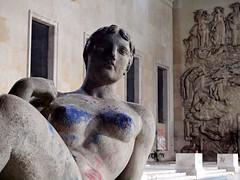
| abused statue (Photo credit: zoetnet) |
Labels:
abuse,
ofenders,
random thoughts
April 11, 2012
Complex vs. Profound
| International draughts board (Photo credit: Wikipedia) |
The stimuli was just a short paragraph of original story, where Allen Poe compared chess game with draughts game (checker in USA): "In this latter (chess), where the pieces have different and bizarre motions, with various and variable values, what is only complex is mistaken (a not unusual error) for what is profound." He believed that it was the games like draughts, who had only simplest rules, can exhibit the highest power of intelligence. (This is the exactly how I feel about Wei Qi).
I found this is indeed a genius thought. As matter of fact, all the modern life seems to become more and more "complex", yet mistaken as "profound" by modern people. A simple example of this is "technology". The computer technology produces more and more technicians, engineers and programmers, who spend most of life time to deal with "complex" of machine, or machine languages, yet end up being utterly puzzled by some basic ideas or language of life itself. Or, if they had ideas about life, they would simply have no time to enjoy it.
Nonetheless, I think this "complex" is unfortunately the direction led by modern life style - we humans are going to that way. Maybe, in another several centuries (or millenniums), we humans would FEEL less, calculate more, and eventually nothing "profound" exist, only "complex", which handled perfectly by machines - a possible more powerful species by then. And whoever still know how to FEEL, would be the slaves of machines.
Labels:
book reviews,
random thoughts
April 7, 2012
Genius, Inspiration and Perspiration
| Animal Genius (Photo credit: Wikipedia) |
Believing genius is 99% perspiration is just a "day dream" which make people believe that anyone can achieve the same as a genius does as long as she/he puts lots of effort . This is totally untrue. To me, such kind of achievement-driven philosophy is neither realistic nor necessary. I think, the only thing one could do to get close to a genius, is to enjoy life in maximum. In this case, one can be 99% same and only 1% difference from a genius (1% of different talent).
Needless to mention, I actually believe we all are genius if we can enjoy our life in maximum.
Labels:
random thoughts
February 26, 2012
Two Different Kinds of Moral Standards:
I understand that there are two type of moral standards: social and humanistic.
The social moral standards are set up for establishing social stability. This includes laws, religion doctrines and common social customs (based on traditional ideology). The humanistic standard is based on our conscience, which belong to our nature. The former favors more on social needs, latter more on individual rights.
History of ethics seems to involve from strict collective (social) rules that prohibited most individual desires or needs, to be more tolerant on individual rights. Examples such as marriage, patriotism, homosexuality, religious, etc. all demonstrated this route.
The social moral standards are set up for establishing social stability. This includes laws, religion doctrines and common social customs (based on traditional ideology). The humanistic standard is based on our conscience, which belong to our nature. The former favors more on social needs, latter more on individual rights.
History of ethics seems to involve from strict collective (social) rules that prohibited most individual desires or needs, to be more tolerant on individual rights. Examples such as marriage, patriotism, homosexuality, religious, etc. all demonstrated this route.
Labels:
collectivism,
ethics,
freedom,
history,
homosexual,
humanity,
individualism,
moral standerd,
nature,
social
February 25, 2012
Insurmountable Beauty On Ice - My Completely "Biased" Account Of Sasha Cohen
| Image via Wikipedia |
I was a huge "Sasha fan", and I still am. I always wonder, how could it be possible for those who really "understand" the beauty of her skating really stand to watch other skaters'? I could not! That's why I quit watch figure skating after Sasha retired.
Of course, my remark is subjective, and I meant to be, because for me, Cohen surpassed all those before her, and is unparalleled by any one after her. For me, not only she had reached the highest techniques (except her jumps), but also displayed the most beautiful form (on ice) of humanity. Like most people who care figure skating already know, Sasha Cohen moved with music, slow or fast, spin or jump, amazing footwork or perfect spiral, her performances expressed all the cherished quality of mankind - grace, love, relaxation, passion, even courage and valor.
I had not caught Cohen's golden time (what a pity!) - approximately 2001-2005. I knew her because I incidentally watched 2006 winter Olympic game and saw her performances. She fell during her free skate program (as "promised"), but her short program was simply stunning. This Olympic participation was proved a very late stage of Cohen's ice skating life, as she retired soon after, but the brilliance of this "sunset" made me searching on internet for all her previous performances (big thanks to youtube). And what I found absolutely made me "falling in love".
Her best performances by my opinion, were those programs during 2002-2004 (under her Russian Coach Titiana Tarasova), such as "Swan Lake", "Malaguena", or "Rachmaninoff" (all of them choreographed by Tarosova - this lady is remarkable!). My personal favorite is Rachmaninoff. She performed this program in 2002 - 2003 season, include 2003 World Championship, which I personally think was her best performance ever, regardless that fact that her fell several time, include one of most impossible fall on ice skating - she fell during flying camel!.
Yes, Sasha Cohen was not perfect - she fell quite often (likely due to her mental barriers), but that doesn't hurt her perfection in my eyes. No doubt she is one of most beautiful female skaters, but she certainly had much more than good looking. She seems to possess a natural talent on positioning, and easily move harmonically with music. Yes, she made figure skating looks easy. And she "visualized" music.
Cohen won a great deal of medals. But unfortunately figure skating is more a sport than art, so she did not won as many as she deserves (of course the judges' biased view was one of reasons too). But this doesn't matter. For me, she elevated this sport onto an artistic level like no one else. As Peggy Flaming said during Cohen's performing "Romeo and Julie": other skaters skate Julie, Sasha is Julie!*
Romeo And Julie
Rachmaninoff
Malaguena
Swan Lake
A tribute to Sasha Cohen
*Sorry I could not find the original source of this comment.
Labels:
art,
figure skating,
sasha cohen,
sports
Subscribe to:
Posts (Atom)