Labels

Chinese culture (16) art (18) book reviews (34) child abuse (10) culture comparison (10) ethics (11) go game (2) history (19) life (76) love (12) movie reviews (20) my aphorisms (97) philosophy/reason (13) quotes (42) random thoughts (146) religion (17) suicide (3)
Showing posts with label Chinese culture. Show all posts

February 24, 2015

Stunningly Stupid Yet Disturbing Materialism Among Chinese Communities

A stack of Money/Picture of money (The followi...
(Photo credit: Wikipedia)
Last weekend while conversing with an acquaintance of mine about economy, I mentioned a person who I knew remotely, who saved $350,000 but soon lost majority of it in stock market. Right after I pronounced $350,000, my story was interrupted by this question: "What? 350 thousand you call it 'rich'"? I looked at him, knowing perfect why he presented such an out of context question, calmly looked at him in the eye and said: "$350,000 is a big number to me."

Of course, I didn't have to admit to him that I was "poor", since it's so obvious, but my point was to exhibit in front of him, that someone just didn't mind to admit how "poor" she was. According to current Chinese "fashion", it's utmost embarrassing to "uncover" your slim wallet. And I have to add, the "poverty line" set by these riches is very high!

June 30, 2014

"Dam Street" - A Chinese Version Of Oedipus Legend

Cover of "Dam Street"
Cover of Dam Street
Yesterday my friend Marty (aka "nothingprofound") recommend me a Chinese movie Dam Street (红颜,literally translation: Rouge Face). He claimed that it was very different from other Chinese movies he had watched. I could not wait, found a streaming video online and watched it right away. After watching it I asked Marty what's the difference. He said that this movie "seemed to be more personal and universal at the same time". I feel exactly the same way.

As a Chinese American who lived in China for the first 30 years of my life, I feel the same way as my American friend who never lived in China, interesting, isn't it? I cannot speak for other Chinese people, but for me, this is the only Chinese movie I have ever seen that I would describe as "honest". From the beginning to the end, there's nothing pretentious, nothing were hidden or added for any different purposes from the needs of story line.

The story takes place in my hometown Sichuan province, the main character of this movie is about the same age as me, almost the same name as well (except Yun is not my legal name), so both geographic and cultural background are all familiar to me personally. Further more, the movie was shot in Sichuan dialect (or Sichuanese), which made it sounds more genuine to me than those made in Mandarins (maybe this is personal judgment, that I always feel the mandarin has "phoniest" accent among all Chinese dialects). The geographic environment is in some small town in Sichuan province, shabby and dirty. To my "horror", first time I saw "traditional" Chinese public restroom on screen (even just one shot, the "horror" cannot be missed). The brutal scene of killing of eels for meal brought me back to those days of my early life. The genuine touch on sexual life is refreshing, especially the boy's sexual fantasy, which was, and still is a "taboo" in Chinese culture.

Of course, all these details are not as important as the story itself. It is about a teenager girl who gets pregnant when she is 16, and since then her fate is somehow "defined", not by herself, but by unseen fate. The story reminds me classic legend of Oedipus, the one from ancient Greece. How interesting it is, that we humans with such different cultures always embark the same voyage in this giant ocean of human life, from time to time, places to places.

This movie premiere was in Venice, won several awards which were not so recognizable. Not sure it's ever screened in China (I talked to my nephew in China and he said he never heard of it). Of course, this is not a surprising treat for a movie without famous actors and actresses, or famous director. However, I am profoundly moved by this movie, and I hope it continues striving for recognition. I also hope the director Li Yu will continue making movies like this, provide the world more truthful images of "modern" China.

June 18, 2014

Institutional Child Abuse In China

I always think, that child abuse is the number 1 problem in China. But, no matter how serious I think it is, the facts never failed to stun me. Based on recently news, there are some new type of "schools" in China, which I never heard of before, called "correctional schools" or "correctional camps", where kids are sent there for the purpose of correcting their bad behaviors, such as obsession with online, etc. Not sure if the concept was actually adopted from elsewhere. During training period, parents were usually forbidden to contact with schools (more ridiculously, many parents granted this rules). The consequence is, children were serious abused (mental and physical) and some of them died.

One girl in this news died by corporal punishment, with was common in this "school" (Zhengzou New Concept Combating school, 郑州新观念搏强学校), called "back crashing" (后倒): several "teachers" held kids' limbs who were face up, and hit ground repeatedly. Sorry, I don't feel like continuing for the details. I guess you all get idea what's the consequence.


http://www.wenxuecity.com/news/2014/06/17/3363520.html

Yet, still majority of Chinese people do not think this is a problem. Something seriously wrong with that nation. Call me paranoid!

June 9, 2014

"Even Chinese Children Won't Get Up That Early!"

Child on New Year's Day
Child on New Year's Day (Photo credit: ROSS HONG KONG)
When Michelle Obama gave speech in Qinhua university during her visiting China just a while ago, she mentioned that she had to work very hard in college, sometime got up at 5 o'clock in the morning. This remark surprised lots of Chinese young students, and one of them posted a Weibo (similar to twitter) message like this: "Even Chinese children don't get up that early."

What does this message mean? It means that in China, children's working hard, enduring stress is something most Chinese people take it for granted!

I have written enough articles about this subject (in Chinese) so I don't feel like to repeat. And I think the above message already speaks for itself, showing what children's life in China is like.


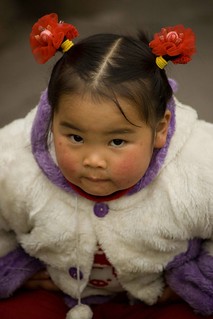
P.S. The image happened to be a little funny. I meant to find a serious one, but this one was too cute to ignore. And I trust her not to take her parents' and future teachers' cr*p!

Enhanced by Zemanta

November 4, 2013

An Open Letter To UNICEF Regarding Family Child Abuse In China

(This letter has been edited by Madilyn Leonard Benrubi, a blogger friend of mine. A big THANKS to her!)

This letter has been sent to:
UNICEF(The United Nations Children's Fund, http://unicef.org/) ;
ISPCAN (International Society For Prevention Of Child Abuse and Neglect, http://www.ispcan.org/) ;
IICRD (The International Institute for Child Rights and Development , http://www.iicrd.org/);


(Caution! The case examples are extremely disturbing!)


Dear Sir or Madam,
I am writing this letter to call your attention to the family child abuse situation in China.
Family child abuse in China has been a serious social problem and it has never been confronted by Chinese society and government. During the recent couple of decades, while China enjoys its economy rising, its spiritual side seems to be more corrupted than ever. Children, the most vulnerable group among the Chinese population, become the worst victims of this moral degeneration.
Here are several severe case examples:

 Case 1: 1993, Xining, Qinghai province. Li Su, a 5 year-old tortured to death by her biological mother. 
A photo of Li Su sitting in a hospital
bed when she was alive.
1993, in Xining (西宁市), Qinghai province (青海省) of China, a 5- year-old girl was tortured to death by her biological mother. Her name was Li Su (苏丽). During her short life, Li had suffered all kinds of mental and physical abuses, including verbal abuse, savage beatings, and starving. More horrendously, more than once, Li's mouth was sewn together with needle and thread. One day when Li was five-years-old, due to tremendous hunger, she begged for food, but what her “mother” did was feed her with hot boiling cooking oil. After this astonishing torture, the “mother” did not send her daughter to the hospital; instead, she continued physically abusing her for several days, until Li finally died of unimaginable pain.
Li Su's mother, Zhiyun Yan, served only 7 years in prison. Now she is a free woman. She destroyed her daughter's tomb after she got out of jail.
http://pilosopogyno.tumblr.com/post/49071586334

 Case 2: 2013, Nanjing, Jiangsu province. Two baby girls were left in a locked home for over 100 days and staved to death.
June 2013, in the city of Nanjing (南京市), Jiangsu province (江苏省) of China, two girls, ages one and three years old, were left alone at home for over 100 days and starved to death, due to completely incapable and irresponsible mothering. The case is still being investigated.
http://roll.sohu.com/20130628/n380124741.shtml

Case 3: 2013, Jinsha county, Guizhou province. A young girl has been brutally tortured by her biological father for over five years.  
"Little Li"'s head was scalded by boiling 
water. She was held upside down by 
her father while her head was put inside
boiling water. Father claimed that he was
only trying to wash her hair.
 July 2013, in Jinsha county (金沙县), Guizhou province (贵州) of China, a man was arrested for brutally torturing his 11-year-old daughter “Little Li” for 5 years, including pouring boiling water over her head, sewing her mouth together, using needles to prick her fingers, etc. The girl suffers tremendous physical and mental trauma.
http://news.sina.com.cn/s/p/2013-05-12/175827099753.shtml


All fingers were pricked by needles.


Case 4: 2013, Shuicheng county, Guizhou province. A 12-year-old girl was tortured by her parents for years. She escaped after being branded with a red-hot iron rod all over her body (including genital area) by her mother, but was sent back to her parents by police.

Xiaoyan in hospital. 
In 2013, in Shuicheng county (水城县), Guizhou province (贵州省) of China, a 12- year-old girl “Xiao Yan” (晓燕)escaped from “home” after her body was branded literally all over with a red-hot fire rod by her parents – mostly her mother. Several days later she ended up at a local police department. After Xiao Yan's father handed a “letter of repentance” to police, Xiao Yan was sent back to her parents. Soon she escaped again due to her parents' continuing physical tortures. This time her parents were arrested and Xiao Yan is allegedly under hospital care.
http://learning.sohu.com/20130126/n364688803.shtml

Branding wounds all over Xiao Yans' body. 

The wounds on her legs. Some of them are 
deep enough to show the bones.


Case 5: 2012, Bijie, Guizhou province. A 6 year-old girl was tortured by her parents with various brutal methods. 
2012, in Bijie (毕节), Guizhou province (贵州省) of China, a 6-year-old girl, Ting Ting (婷婷)was found astonishingly abused by her parents, torture methods included kneeling on a nailboard, slashing with iron wire, branding with a hot iron rod, etc.
http://tieba.baidu.com/p/2002957291?see_lz=1

Branding wounds on Ting Ting's body.


The stove used to prepare hot rod that 
were used to brand Ting Ting. 

Case 6: 2013, Nanjing, Jiangsu province. A group of young girls was forced to beg naked on the street. 
2013, in Nanjing (南京), Jiangsu province (江苏省) of China, images of a group of young girls naked and begging on the streets stirred some attention online and soon, one of the girls was found by police. She was forced by her parents to go on the street begging naked to “earn” more money.
http://news.sina.com.cn/s/p/2013-07-04/173127578392.shtml


These are just a few samples that have been already exposed. We can reasonably imagine that there are many more similar crimes still hidden and ongoing. The real horror behind these astonishing crimes is not only how brutal they were, but also the fact that they were not committed underground. All these sample cases were more or less known to neighborhoods, condemned by some people even in the media, yet they were still not stopped. The first case (Li Su, 1993) was reported in newspapers several times, but Li Su was nonetheless left alone until she paid the ultimate price. All these examples reveal a fact, that child abuse, especially family child abuse in China is not well recognized by society and not effectively supervised and punished by the law. Children in China who suffer from family abuse are not properly protected, and we could even say, based on the cases above, those children were not protected at all.

Besides these types of extreme crimes, the relatively milder child abuse in China is much more “visible” and can be seen almost everywhere. Here are some statistics created in a research paper: Child abuse in China: a yet-to-be-acknowledged “social problem” in the Chinese Mainland, created in 2004, by D.P.Qiao and Y.C.Chan from Capital University of Economics and Business and Hong Kong Polytechnic University: http://www.acad.polyu.edu.hk/~ssycchan/Child%20Abuse%20in%20China%201.pdf

 “There are at present no national statistics on child abuse in China, but some survey data will throw light on the problem. In 2001, a national survey of 3543 married people conducted by the China Law Society showed that 71.9% of the interviewees reported to have had the experience of being beaten by their parents during their childhood (Liu & Zhang 2002). In Beijing, it has been found that 6 in 10 students had experienced physical punishment and disguised physical punishment from their teachers (Hao 1999). In a parallel study on primary students in China and Korea between 1998 and 1999, 70.6% of the Chines children had experienced family violence in the year preceding the study and the rates of corporal punishment by teachers were 51.1%.”

The seriousness of Child abuse in China has been ignored, covered, or disguised by both government and society, consciously or unconsciously, due to many complicated reasons, such as cultural tradition, nationalistic sentiment, politics, etc., and it certainly cannot be changed overnight. However, in this 21st century, I believe Chinese children need to be watched by all people in the world who are concerned about human rights, because a significant number of Chinese children are being treated as less than human beings (even less than animals), living in a dire situation that causes them unimaginable suffering. I sincerely hope that the international organization of UNICEF can make some effort in regard to this serious matter. 

Thank you!

Sincerely,

Yun Yi
An ordinary Chinese American and a humanist


July 28, 2013

Disappointment And A "Period"! -- My Battle With Confucianism Is About to End

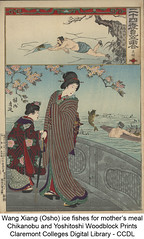
Wang Xiang (Osho) ice fishes for mother's meal
Wang Xiang (Osho) ice fishes for mother's meal (Photo credit: Claremont Colleges Digital Library)
It has been frustrating. After I initiated two blogs and one facebook page for Su Li's Day (a day for remembering a girl who was tortured to death by her own mother, also for all child abuse victims in China), a netizen friend suggested that I should write a petition (a joint signed letter) to legislature in China, to appeal for actions in Chinese government to concern this issue, to establish a more executable law and some organizations for children's protection. I thought this was such a great idea. Though I knew this may not work out, I wrote a draft nonetheless, just to see how far this could go. However, after I posted the draft in the forum of CND (Chinese News Digest) and another Chinese popular website, asking for advices or suggestions, and support (by sending me their "signatures", basically just names), the responses were very disappointing. Only a few people responded, most of suggestions were neither geniune, nor relevant. And needless to mention some of them were scornfully discouraging. Even though dozens of people supported the idea before I made draft, only two people sent me their signatures after 3 days since I posted draft.

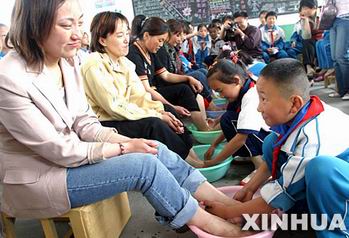
In 2011, some school activity: washing parents' feet. Serving 
parents (like "slaves") is the primary teaching of Confucianim. 
Personally, I do not believe China has much hope from within. If we want to see some progress in humanity in this society, some fundamental cultural ideology has to be changed, even eliminated, but very few Chinese people would agree on this view. Many people (include some none-Chinese) might see China appears to be very strong now, but please be aware, that the recently decade of soaring economy was promoted by international markets, together with all imported technologies. Under such glowing surface, the disparity of rich and poor, the degeneration of morality accelerated by the same speed of economy rising. And for solving moral problem, again, Chinese society turned to Confucianism, an ancient outdated yet lifeless ideology based on ancestor worship. This ideology was superficially "destroyed" by Mao, especially during Cultural Revolution, but after economy "prospered" during recent couple of decades, Confucianism not only did not weakened, but revived. I was saddened a few days ago when I heard that "24 Filial Piety Exemplars", a notorious traditional Chinese moral teaching text, virtually nothing more than a book of child abuse, again appears in some elementary schools' textbooks in China.

After being disappointed by all of these, I realized, that this open letter I drafted, which nonetheless will be read by some people, would be a "period" of my over ten years serious thinking about this subject - how the widely spread child abuse in China relates to Chinese tradition. As an individualist, I have no interest, nor energy to involve in any social activities, writing this petition letter was completely motivated by my own personal conscience. And I am fully aware of that this petition will be like a water drop in ocean, soon disappears without any trace of it. I am just fine with that, because I understand, when facing such a stubborn tradition, the real solution lies in collective effort. And if the society doesn't make any effort, or if the collective effort went to wrong direction, the solution would have to rely on some natural/historical mechanism, which doesn't always favor human-interest (if you know what I am talking about).

Yes, I am disappointed, but not personally unhappy, because my interest will move on, from this "Chinese problem", to some much more fascinating "human problems". (Oh boy, I am certainly not a problem solver, but a problem finder. :-))


*The illustration above is one of 24 Filial Piety Exemplars which tells a (adult) son lying down on icy surface of river, using his body temperature to thaw the ice, in order to get fishes for his mother to eat. So please don't be fooled by the beautiful art style, the content is sticky!


Enhanced by Zemanta

May 30, 2013

"Qingwen" - A Children's Day Memory

Chinese children
Chinese children (Photo credit: Wikipedia)
(Caution! I tried my best but some of description of physical abuse can be disturbing to some people.)
(This is a translation of my Chinese essay with the same title.)

------------------------------

I don't usually celebrate June First - the international children's day. However this year seems to be a little different, I've been thinking about one of my childhood friend: "Qingwen", and like to write an article about him. I don't remember what his family name was, nor how to spell his name in Chinese characters, because I have not seen him again since I was 5 and half year old, and for all these years, or decades I should say, he was totally absent fromn my life. Now, as Chidren's Day is coming, he suddenly came back to my mind.

When I was 4 or 5 year-old, both of my parents were too busy (working "for Communist Party and the Country") to take care of me, so I was sent to a temporary foster family. It was not so temporary though, I lived with the family at least 2 years. The family name was "Guo". Mrs. Guo was an old lady and everyone called her "Mother Guo", I called her "grandma". Even though non of my grandparents were alive upon the time I was born, I felt "Mother Guo" was indeed my grandma. Mr. Guo - to whom I called "grandpa"-  also treated me kindly, so did all their children, who were all much older than me. I received plenty of love in this family and I felt more attach to them than to my own parents. Though overall my childhood was dark, the years I lived with this family was bright, except one shadow, which was Qingwen.

Qingwen was a son of a single father, who lived next door to Mother Guo. He was about the same age as me, or probably slightly younger. I cannot remember how he looked like, nor what kind of games we played together, but it doesn't matter, because what I am going to write, is not his biography, but the only memory he left in my mind: a child who was abused terribly by his own father.

Mother Guo's house was a in one-floor building complex, in which 3 families resided. Guos was in the middle, contained multiple rooms, which was a luxury at the time. On the left side, was Pens' family, whose youngest daughter was my best friend; on the right side, was Qingwen's home. His home had only one room. None of our friends visited his house, occasionally we would take a "sneak peek" of inside from the door, it was dark and lifeless. I could remember seeing a messy and dirty bed, a table, a few chairs, and some random items scattered on dirty ground. Qingwen's father was a blue laborer, I don't remember what kind of job he did, all I remember was one of his eyes was blind, and he was always drunk.

It seemed that Qingwen's father went to work everyday, left his son alone at home. So Qingwen played with us sometime. When his father came back late afternoon, if he was in good mood, Qingwen would be OK, but if not, Qingwen would get beaten up for no reasons at all. Usually the "father" used some sort of bamboo stick slash son's hand, but in "severe" cases, a hot red metal fire rod would be "necessary". We often heard crying from next door, but it seemed to be "normal", and it was no body's business. I don't remember how many times when I passed his house, saw Qingwen was tied up on a tree in front of his house, crying alone, looked at me in despair. I also remember, not only once probably, when I passed their door, I saw his father using a red fire rod to slash his bare feet. The "father" was yelling something, and when his voice raised up, the red fire rod would land on Qingwen's naked skin. Qingwen was jumping around with unimaginable pain, and screaming. I also remember that he always screamed before the fire rod touched him, with that unspeakable fear, and when it touched on his skin his scream was simply just louder, probably loudest he could make. He must wanted to escape, but he had certainly nowhere to go, also he was ordered not to, so all he could try was few square feet area, jumping back forth like a crazy little animal.

I often saw Qingwen was tied on tree, but never saw his father torturing him while he was tied. Qingwen was beaten always while he had his hands and feet "free", and no matter how much pain he suffered, he always stay in the same spot after jumping or crying, "voluntarily" gave his father's "job" the most "convenience". His father sometime even could sat comfortably, made his son creaming and jumping by easy lifting of his arm (How powerful was that!). Years later I realized, that tying Qingwen on the tree was actually for another kind of "convenience" - the "father" often went out (probably to buy liquor), but he did not want his son making "trouble", and did not want to bother neighbors, so the easiest solution for such "problem" was tying his son up.

Probably because back then there was no ventilate system inside houses, people would put their stove - the old fashioned coal stove - outside of house. For a few times, I (together with some of my playmates, I guess) stole the fire rod from stove, either put it in water, or threw away. That might be the only help Qingwen received from people, and obviously, it did not help him much. For after all these years, the only memory jumps into my mind, was still his despair expression in his eyes when he was tied on the tree, watching me passed by quietly.

Though there was Qingwen's misery, I was too young to understand the kind of misery he suffered. My life in Guo's family overall was happy, everyday so many fun things to play with. It was later, after I had similar experience, after I acknowledged what child abuse was, how it would traumatize one's life, I started thinking Qingwen again, started imagining what kind of horror he lived with daily.

Qingwen was not at all an unusual case in China. Regardless my own experience, many of my friends and schoolmates were severely abused. For example, one of my high school friends was often threatened to be "thrown out" from family, often got beaten with no reasons, and once was almost strangled to death by her mother; one of my classmate in elementary school was not only beaten by his father often, but also "treated" by pliers (how his father used this device we could only imagine); in the school my parents taught (where I grew up), one of professors tied his son and hung him up, then beat him. However, all these cases, include Qingwen's, would be considered as "merciful" if compared with the one that happened in 90s of last century - which was only less than 20 years ago - in Qing Hai province, a girl whose name was Su Li, was tortured by her own mother for years (beyond any sane human beings can imagine) until her young life could not bare any more. She died at age of six.

I often don't understand why so many Chinese people are so "unfamiliar" with the terms and behaviors of "child abuse", as if this kind of crime is some "particular production" of Western society (a Chinese lady I know literally told me so), just because they "invented" this term. Are they blind? Or they are just numb about life, don't think children could feel? I personally would say, with just a little exaggeration, that the entire history of Chinese morality is a history of child abuse. Sounds extreme, right? If you think so, you may be interested in reading "24 Filial Piety examples", or1994 the fire accident in Karamay, Xingjiang province. Yes, in the past and present history of China, children have been something "spendable", for some "higher moral purpose", or for any purposes.

LuXun in the 1930
LuXun in the 1930 (Photo credit: Wikipedia)

After I entered middle age, I wrote lots of essays (in Chinese) about child abuse in China, about how it is connected with Chinese tradition, especially "filial piety". But writing this short post, I do not mean to do the same kind of "rational thinking", rather, I want to have an emotional touch on my far lost memory, to remind myself, and hopefully others, that this kind of experience, though better be forgotten by its sufferers, should never be forgotten by society, because only when a society recognizes the existences of such abuses, defines them as crimes, it can start rebuilding a new environment for children to grow healthily.

I am not a racist, nor a nationalist, but I would still like to dedicate this post to Chinese children, because they have been suffering too much for too long, and their suffering has been always overlooked, covered up, forgotten, even justified by so called "cultural tradition".

Remember Qingwen, remember Su Li, "Save the children!" (Lu Xun)


*1994, in Xingjiang province

Enhanced by Zemanta

January 30, 2013

Where Does Evil Come From - My Thought On Massacres During Chinese Cultural Revolution

The Cultural Revolution hunted the political a...

(Caution: even though as a writer I always spare gruesome details, still, if you do not have the nerve to confront the darkest darkness of human nature, don't read this blog!)

People always put the word "kind" to all the weak individuals, but what they do not know is, the reason some of these individuals appear to be "kind" is only because they do not have chance to be evil. --- Hu Ping

I was born a year before Cultural Revolution. I don't remember much of violence diffused all over the country during my childhood. I heard there was a bullet shot on the window of our house (barely two rooms with a small kitchen), which just missed my head, while I was sitting in my nanny's lap. I heard my father's concussion was caused by 4 red guards holding his body upside down, then hitting downward to the floor of the stage - before which some hundreds of people were watching, including me, who was crying. I heard one of professors was tortured, in a way I felt difficulty to describe; I also heard some "rumors" about cannibalism that took place in some countryside of China. Still, rumors were just "rumors", the life of my first 30 years in China was "peaceful" (if we don't count the violence happened within families).

Recently I read part of book: "The Myth of Blood", a book that was written over 20 years ago and finally got published in Hong Kong in 2010. The book documents carefully about the mass massacre that took place in Dao county, Hu Nan province during summer of 1967, right after Cultural Revolution began. The brutality of this massacre was absolutely beyond anyone's imagination - during 3 months of mass murder, over 9000 people died (among which over 1000 committed suicide) in that county alone, most of them by torture. A local river ran red for months. Once this beautiful place was well known for the fishes from river, but after massacre, no one bothered eating fishes for years.
Intrigued by this book, I traced some online sources about another "well-known" massacre took place in Nan Ning county, Guang Xi province. Those sources proved the "rumors" I heard long time ago. This massacre was even more gruesome, mostly due its widely practiced cannibalism. What's even worse than just cannibalism was that the cannibalism here was often "practiced" during victims were still alive. It seems no one really know how many people died in that place during massacre, some sources say 50 or 70 thousands, some say hundreds of thousands. No one knows for sure.

These two massacres were not all happened in countryside of China during Cultural revolution. There were many other places suffered the same horrors. As Deng Xiaoping once said (source from online): we would never know how many people died during Cultural Revolution.

I was shocked, first by the brutality, second by the people who involved - they were mostly "ordinary" people. These massacres were not government "organized", or "state-promoted" crimes, they were "mass movements" that everybody participate (more or less) voluntarily. These massacres usually started by two groups of people who fought violently, yet both sides claimed loyal to Mao and Communism. And when these movement went into absolute chaos, more people involved, then the "excitement" was no longer "political", or "ideological", but absolutely frenzied and devilish.

The details were incredibly gruesome, I think they would be the best described by Mo Yan's style, not mine. However, here are a couple of them I could put in brief: in Dao County's masscare, one person tried to hang himself but he was just a little too late, he was "rescued" by his "enemies", and then tortured in many different ways until he died. During massacre of Guangxi province, it was said one old (ordinary) lady first got a heart from a victim, but after she heard that the organs from died bodies did not have the best curative effect, she threw it away, and eagerly participated the next more frenzied action in order to get a fresher one...

Ignorance does kill!

Honestly speaking, I would prefer these crazy people all had guns, so the victims could depart the earth more mercifully. The fact was, without guns, these Red guards or Red comrades were just become incredibly "creative" on killing. Again, I am not interested in details of those "techniques".

Can we blame this type of crime to Communism, or to Mao, to Chinese government? I simply cannot. It is obvious that most of participants of such movements were volunteer commoners, free to do or not to do anything that they "felt" "right" or "wrong". There were some forced actions, but certainly not all of them (I supposed not even most of them). And there was no law, no moral stance, only evils unleashed. Yes, Mao might be responsible for unleashing such evils.

What continued to strike me is, all these horrors, almost vanished from people's mind immediately after they ended. No body talked abut it, neither no one was punished by laws (of course there was no law). Most of those murderers, those who ate other humans organs, flesh, just went straight back to their "ordinary" life, many of them even played victims of history. It seems some were later arrested for murder, but how those "trials" went I do not know for sure. What I can be quite sure is that majority of these people who committed the most horrible crimes in human history lived peaceful lives until they died, or some of them are still alive. The whole massacres were all forgotten. No one mentioned them at all, until this book of "Myth of Blood".

Or maybe the reason of such crimes were forgotten by many is precisely because they were committed by "many"?

I somehow understand this type of "oblivion", because it is indeed too dark to mention. Except, dark history would not evade repeating itself just because we choose to forget. As matter of fact, similar crimes happened also during Great Leap Forward, which was only several year earlier than Cultural Revolution. "Good" thing is, many crimes - include cannibalism - happened during Great Leap Forward were covered by "starvation" - a much more sound and face saving term than "massacres".

Another side of story is, there are things that Chinese people chose NOT to forget, such as how the intellectuals were persecuted, how the "precious" Chinese tradition was destroyed, etc. Think carefully, it is not that strange at all, because those who write history can choose what to write, what not to write, and in China (also elsewhere), it is "intellectuals" who write history, so "understandably", after cultural revolution, intellectuals' fate was much better documented than those peasants who lived in countryside, despite the fact that what happened in countrysides were much more "serious".

I am not an expert in history, but by my limited knowledge, I still have to say, I simply could not find any part of human history darker than this part of Chinese history. The reason for that is, these massacres were not "wars" between nations, neither state organized, but just "mass movement" consisted of "commoners", yet they reached a stunning level of destruction and brutality.

How could such things happen? If we cannot blame these horrors to minority powerfuls, or those abstract ideas, such as "communism", where can we find an answer for such insanity exhibited by these mass "common" people? Were they just temporarily possessed by Evil?

If so, where does the EVIL come from?


January 16, 2013

Compliments From Parents

Ming Tang, Yan Bai, Grace Tang, Ming's  parent...

Since I started art classes in 2009, I have very few American students, however, the cultural difference doesn't escape even in such an unbalanced proportion, that is how they compliment their kids: American parents's compliments were loud, directly made to their kids, Chinese parents' compliments mostly were not loud, and usually not directly to kids, but to me, such as "oh, she seems doing better," "looks like he made some progress."

Of course, I hardly heard any criticism made openly, but I know in China, I would. It is widely believed in Chinese culture that humans were born "bad", so criticism is constantly needed. By Confuciansim virture is learned and vice is always a born nature. That's why in China, education mean "discipline". It is also a custom in China that when kids doing good, people naturally praise their parents and teachers, and when kids did something bad, people would condemn kids alone.

Yes, Confucius also said something like "it is the father's fault if the son did not behave well", but that's just some old cliche that nobody really believe in real life. What is really believed by Chinese people, now and then, is that compliment definitely will spoil kids. That's why most Chinese parents just don't give compliments to their kids. In case that compliments are desperately necessary, they must be presented in very reserved way, such as indirectly, or spoken out with seriousness, or better followed by criticism, just to make sure kids know that they are not really that good.

Also, I believe generally nature plays a rule of "balance" - we treat people by how we are treated. Most of these parents were treated harshly when they were little, so they naturally get so "stingy" on compliments - which they did not have much "saving" in their own emotional account.

Not only compliment, according to Chinese tradition, LOVE, should also be expressed in reserved way. I kind of understand, if we were born "evil", how could we deserve good thing? I myself as example, I don't remember being ever held by either of my parents. My father would pretend he did not see me if he encountered me in public areas. Through all my adult life, I had not touched my parents until my last visit back in China, which was 5 years ago, when my parents both were too old and sick (and if I did not hold their arms, they probably would fall down). There is a book out there called "Chinese People - a race without hugs". My personal experience certainly proves that. But I know this is not just about my experience,   every Chinese person knew this is true, despite there plenty of exceptions.

I believe we human are such animals, that if anything that is essential to our nature was deprived at the beginning of our life, such as foods, love, more likely than not, we would struggle with this issue for the rest of our life. I don't remember where I heard a story about one person who had a "hobby" to store breads everywhere in his house only because he was once almost staved when he was a child. Same as our confidence, or self-esteem, if one was not proved by her/his parents from beginning, he/she might spent all his/her life to look for prove. So I believe, psychological wise, one of important reasons for the overwhelmingly diffused social competitions, insatiable need of career success, money and fame among Chinese people*, really stem from most of Chinese people's childhood: lack of proof from parents - our first connection with the world.


*Of course I do not mean that this social phenomenon is exclusively occur in Chinese culture, but I do mean that in Chinese culture, it appears to be overwhelmingly disseminated.

Enhanced by Zemanta

July 24, 2012

From "Anti-Chinese" to "Original Humanity" - 5 Reasons Why I Dislike Chinese Culture

Great chinese wall atSimatai

I am getting more and more indifferent about the situation of China, good or bad. I seldom read Chinese books, literature or history, almost never watch Chinese TV shows or movies. As matter of fact, I have been like this since I entered this country (USA). In Chinese forums where I participate discussions I have been often accused as "anti-Chinese" or "racist" (my recently short post of 10 favorite books also resented many Chinese fellow netizens simply because none of those books are "Chinese").

I might deserved this label, depend on some superficial understanding of "discrimination", but based on my own understanding, I am not. I am an individualist who is fully capable of differentiating individuals from population, treat each of them individually, regardless their races or nationality. My indifference about "Chinese" is not derived from "hatred", but solely from "personal interest": "Chinese" culture doesn't seem to interest me that much any more.

And there are reasons. It seems to me that thousands years of monotonous "culture" or "civilization", together with "communism" somehow changed, "tamed", even distorted Chinese culture. Among Chinese cultural heritage and contemporary lifestyle, I just don't have a taste of "original humanity".

What is "original humanity"? This is of course a serious subject which deserves a whole hundreds pages of book. But writing (or reading) such book is beyond my current capability (not even mention my back pain), so I would try to appreciate simplicity a little: original humanity can be as simple as "the quality that we possess by nature". Or in other words, it is the quality that has not been stained or "polished" (depend on you view) by so call "cultures", "civilizations", or even "human intelligence" (in a sense of “superior to nature”). Based on this understanding of mine, I found that Chinese culture has been overly “cultivated” so that it lost many natural traits.

Below are several major reasons that I found Chinese culture "anti-original-humanity" (by my own words):

1. Lifelessness: among most of Chinese traditional or contemporary intellectual works (art, literature, etc.), I seldom found any works that praise life for the sake of life itself.
There are many art or literature works praise "Chinese" as a nation, praise her over 4 thousands years of tradition, praise "empire" or communism, but we cannot see many works that show the beauty of human life (or of humanity). Sure there are many art or literature works praised the beauty of nature, expressed the harmony between human and nature, but instead of the direct appreciation of the nature and life, they were more serve as an escape from human world.
The direct reason for this is, by my opinion, that so many Chinese people have been deprived from being capable of enjoying life. Their lives always had/have some preset "purposes", such as serving for their country, their families, parents, their rulers (emperors or communism) , but never, ever for themselves. For lots of Chinese people, life has value only when it is sacrificed. Second, is the religion aspect of Confucianism: "ancestor worship". Such tradition made Chinese people take it for granted that "dead" is more important than "life", parents are entitled to have power over children. This, is the root reason (cultural wise) of why Chinese culture lacks "life".

2. The worship of man-made order: Confucius was fond of "man-made order", despised passion, inspiration or spontaneousness. This affection to "man-made order" was accepted and followed by most Chinese people, of both ancient or modern time, and it made Chinese culture too "patternized" to be interesting or adventurous. While this trait was already bad enough for art (as matter of fact, I love many type of Chinese art, for their "irrational" characters, but I do dislike its monotonous style), it was absolutely "lethal" in ideology field - it made Chinese people held same idea for thousands years. What can I say except "lazy brain"?

3. The "murder" of individualism: I personally believe that Chinese traditional and contemporary culture (Communism) together have successfully "murdered" "individualism". Or, be more specifically, individualism never existed since Chinese civilization (agricultural) began.
By my poor knowledge of history, I know that one of the major differences agricultural civilization made from the previous civilization (hunting and gathering) was hierarchy system, in which individualism had no room to grow. China, one of the oldest agricultural civilization that is still alive today, is certainly a perfect embodiment of this hierarchy system: from social to family, from art to “science” (the reason I put exclamation mark is I still don’t think Chinese culture has true scientific spirit), literally, you just don't see any clue of "individualism". Or if you saw any - such as Lu Xun, even the classic novel Dream in Red Mansion, those works would almost no exceptionally tottered into the fate of be misinterpreted (“rape” is a more accurate term here) by mainstream intellectuals, serve all different political or social purposes.
By my personal understanding, individualism truly is humanism in its most direct and personal term. However, among Chinese intellectuals (ancient or modern) it has been an issue of the least concern, or not concern at all. That’s why we absolutely found no sense of "self" in almost all intellectual fields. So you may think Chinese people are the most altruist people in the world? Well, ironically, you probably would find it's just opposite (if you have chance to live within Chinese culture long enough), and the reason for this is, (I think) when our decent personal needs are completely deprived, we tend to find some "indecent needs" through "indecent" way, as complementary to this "tremendous loss".

4. Poor intellectual creativity: Lack of individualism inevitably led to lack of creativity. If whole group of people "create" same style of art, state same kind of ideas, we better call these works "products", not "works".
Lu Xun once said, "we better read less Chinese books, or, just not to read them at all" (I cannot agree more!). As Lu Xun, Liu Xiaobo and many other (actually not "many") independent thinkers pointed out, Chinese intellectuals never has been an independent class through Chinese history. Their lack of courage made them always lined up with ruling class. This fact made Chinese intellectual heritage extremely monotonous and insipid.

5. Overwhelming/morbid sadness: There is widespread overwhelming (even morbid) sadness in Chinese art, music and literature, from ancient poetry to modern pop songs. I have been wondered why, but not anymore, because the answer is obvious: the deprivation of "life". Since they (or "we", because even though I am not a Chinese by nationality, nI am still a "Chinese" by "blood") were born, they were "trained" NOT to live for themselves, thus they/we never feel the ownership of their lives. Of course it is sad!

Above are the reasons why I dislike Chinese (main stream) culture. By my opinion, they are all too far away from our original nature, too tamed and "cultivated", not room for change, for freedom.
Of course, I understand any culture has its good and bad sides, and the traits listed above also exist in all cultures, not only in China. But the difference is, in Chinese culture, they are overwhelmingly dominating. And it is exactly this domination that made/makes Chinese culture extremely monotonous and lifeless.
I believe China as a country and political power will not only survive, but also persper due to its economic rising. However, it's mainstream culture - Confucianism, will not be so influential to the world as Chinese economy. As I understand, diversity is the key factor for any organisms to survive, it must be crucial to cultures' survival as well. For this reason, I don't think Confucianism would survive long. As matter of fact, to myself, it already died long time ago.

Enhanced by Zemanta

October 19, 2011

What's Wrong With China!!!!!?????

For long time I have not read much Chinese news. Today I went to a Chinese forum which I used to hang out a lot, and encountered a thread which shows video of a little girl being run over by a truck (twice). It is extremely emotional disturbing and doubtless ruined my day!
A beautiful girl (about 4 or 5 year-old) was run over by a small truck. The truck stopped for a few second, then started again, ran over the girl by the back tire again. For about 10 minutes, people walked by the girl, as if she did not existed, until later a middle aged lady came, saw what happened, and rush back in building. A moment later, a young lady looks like the girl's mother came out, took the girl and rushed away. Later of the video shows the interview of the father, and the mother's desperation. It's heart breaking!
The article in the thread tells more details: the girl is dying. She ran to street while her mother was doing laundry...
I am not giving out the link of the video, cause it caused me trouble already.
There is something wrong with China, something very very wrong! I am not worry about those corrupted government officials, hypocritic "intellectuals", complacent new riches, but only one type of life: CHILDREN, the only lives that are innocent, not responsible for all the darkness, poisonousness of society, yet suffer the most, from some extremely distortion of human nature.
What it is? I do not know (at least not with 100% certainty), yet I am still speechless!

February 4, 2011

Materialism, Who Is To Blame? --- An inquiry into Chinese cultural tradition


Confucianism, Taoism, and Buddhism are one, a ...Image via Wikipedia


Edited by Anji Sandage

From a philosophical point of view, materialism represents some of the most negative aspects of our human nature, such as greed, selfishness, and inhumanity. It would be unjustified to put the label of “materialism” on any single ethnic group. However, being Chinese, I find it hard to ignore the excessive materialism in modern China, where money seems to be the sole “religion” in many people’s lives.
There are many reasons for this phenomenon - poverty, the social system, and even communism itself, but I have found all of these reasons to be superficial. I believe many Chinese people's “passion” for money has little or nothing to do with the reasons listed above. Instead, it has EVERYTHING to do with Chinese cultural ideology.
In China, there are two influential classical philosophies - Confucianism and Taoism - that dominate Chinese cultural ideology, and have for thousands of years of Chinese history. Both of these philosophies focus primarily on the practical aspects of human existence, or the “mundane.” Briefly speaking, Confucianism is about social stability while Taoism is about individual happiness. Even though Buddhism came to China during the early part of the first millennium and has undoubtedly had a great influence on Chinese culture, like Taoism, it is still a belief system focused mainly upon individual happiness. Soon after Buddhism spread throughout China, it quickly merged with Chinese culture and branched off into several sects and schools, the most common being Zen Buddhism, a school of Mahayana, with a following of between 500 and 1,000 million people throughout Korea, China, Japan and Vietnam.
Before the 19th century, China was almost completely closed off from the outside world. When China first opened its doors to the west in the middle of 19th century, these two philosophies were the whole content of the body of knowledge understood by Chinese intellects. It is a common belief in China that Knowledge isn’t something that can or should stand alone, but rather it is a subsidiary part of political or practical life. In ancient China, the only purpose for gaining knowledge was to gain political and social power. In his book “Mist of Metaphysics” Liu Xiaobo stated:
"One of the characteristics of Chinese culture is to provoke the human desire for power as much as possible. The path to becoming an intellectual is almost the only way to reach this goal.” [1]
In Chinese culture, there is no concept of "God" in a monotheistic sense, no sense of "divinity," and no concept of absolute "truth," neither was there any scientific spirit that existed in ancient China. In other words, there were no existing bodies of knowledge other than those with the purpose of serving mundane life. I believe it was exactly this monotonic understanding of knowledge that has shaped many Chinese people’s materialistic attitudes toward life.
Certainly both Taoism and Confucianism did not teach people to be greedy, but one important idea that both of these philosophies teach is that there is no need to question or look for anything other than matters directly related to the practicalities of life.
Taoism is a very charming philosophy and can be understood in a very positive way, for example, the ideas of following our natural spirit and making harmony in our lives with or without material comforts are very appealing to many people, and I believe this truly was the original intent of Taoist philosophy. Unfortunately, this aspect of Taoism has only been taken and practiced among some intellectuals, such as artists and poets. Among most others, Taoism was simply understood as a pathway to physical comforts and happiness.
Under such a cultural background, when China once again opened its doors to the world during the 80’s, it was more than willing to embrace capitalism, and people’s materialistic desires that had been suppressed by traditional morality for thousands of years were finally unleashed under this perfect marriage. This is why even though China is completely under communist rule; it was still able to combine the communist political system with a capitalist economic system.
Some people may blame Communism for this materialism. I would totally disagree. Not only does Communism not encourage materialism, it encourages a kind of "puritanical" lifestyle in modern China. During the 50’s, China experienced a very anti-materialism social movement where almost everyone lived in very poor material conditions, but with a zealous mental enthusiasm similar to Europe during the middle ages. Needless to say, this did more harm than good. It created one of most devastating horrors in human history, now known as The Great Leap Forward, which cost tremendous loss of life. After that, Chinese people lived in very poor conditions until the 1980’s when China once again opened up to the outside world.
I truly believe that while materialism exists in every society in this world and greed is truly a common disposition of human nature, some types of cultural ideologies encourage such philosophies and dispositions, while others discourage them. I personally view the overwhelming growth of materialism in modern China as a consequence of the poor development on Chinese intellectual property.
Once again, to quote Liu Xiaobo:
“…The worst regression in Chinese history was the revival of feudalist ideology”[2]


[1] Mist of Metaphysics, by Liu Xiaobo
[2] Mist of Metaphysics, by Liu Xiaobo
Enhanced by Zemanta

August 14, 2010

"Mom, stop pretending to know something you don't!"


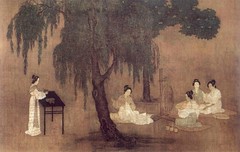
007.女孝经图(之二)

Image by xdanger via Flickr
"Mom, stop pretending to know something you don't!"
Another day in my art class one of my students (12 year-old) said this to her mother. I just cannot forget it.

For thousands years, being completely obedient to parents has been #1 moral principle for Chinese people. Disobeying your parents is like "taboo" to Chinese people. The most important teaching of Confucianism is "Xiao", which mean obeying and serving parents unconditionally. By my opinion, before China opened the door to the world over a century ago, all Chinese kids had been treated as lowest class human being since the beginning of their lives until they were parents themselves (upon the time they of course were still their parents' "slaves" but they also got the right to enslave their own kids as they wished). That's why one of Chinese authers Lu Xun screamed out "Save the children!" (in his most famous short stories collection "Call to arms" during early of last century).

Of course, situations have been changing since a century ago, but this tradition - the unconditional responsibility of children to their parents - still has been carried on (more or less) by Chinese people to wherever they go, because it was considered as a iconic culture element - without it, you are not a Chinese.

In my art classes most students are Chinese Americans. They are influenced by 2 quite different cultures - Chinese tradition from their parents and American culture from schools, or anywhere else outside of their families. However, by my observation they are 90% Americanized, while their parents - who are mostly the first generation immigrants - are mostly still very conservative in terms of Chinese heritage.

The parents of one of my students in painting class seemed to be one of the most traditional Chinese couples I have meet in this country (USA). They "love" their daughter, but they could not help to keep pushing her to the "perfection" they aimed for her on everything. They usually stayed in my classes, sometime the mother sometime the father (I let the parents stay if they don't have places to go), watching their daughter's performance even closer than I did.
One day the mother was in class, highly unsatisfied with her daughter's painting, could not help to stand beside daughter and gave her instructions of doing this and that. Of course her daughter was extremely annoyed and kept complaining and fighting back by refusing to follow her mother's "command". "I don't want to do it. If you like, you do it!" She said. To my surprise, the mother grabbed the brush painted couple of small things on the painting. I was seriously worried at the moment that daughter might be just so pissed off and destroy the canvas. But she didn't.
Feeling somehow obligated for some detailed instruction, I picked a brush to help the daughter to fix somthing on her painting. I mixed color and painted on canvas and mother immediately said "see, now it's right". Unfortunately, before she finished the sentence, I realized the color was NOT quite "right" and threw some words like "oops, that's not quite right." And the daughter just quickly captured the moment and said it very loudly: "Mom, please stop pretending...."

Hearing the daughter saying that so loudly, I was somehow relieved. I saw her acting like a brave girl who was able to be truthful to herself, regardless her selfish and demanding mother. Another time I heard some other students referred this daughter as a little "strange", "easy to get irritated" person, but I believe as long as she could be brave enough to let herself stand up in front of her parents like that, she will be fine.

This is just one small happening but it does tell me that something fundamental about Chinese people is changing. I cannot imagine I say the same thing to my parents when I was 12. And I never heard any of my contemporaries said similar things to their parents at this early age. I am just very pleased to witness such an rebellious action taking place in a traditional Chinese family.
And this happening undoubtedly enhanced my belief in "equality" and "liberty". As soon as we taste them, we cannot live without them.


----------------------------
*The picture is one of illustrations from a Confucian teaching book - the part that teaches how women should behave and serve their parents and husbands, which I have not bothered reading any yet. But the art works were excellent though.

May 7, 2010

Lu Xun

Ningbo peopleImage via Wikipedia


Lu Xun, a writer who lived in early of last century, criticized Chinese traditional culture in a way like nobody else. He was almost the only one I consider as a true individual thinker during modern Chinese history. He was called "Nietzsche in China".
In one of his articles he mocked about someone who tried to write a book about chinese history:
(These are not the original words but what i remembered)
Why do we need to write a BOOK about Chinese history? that's a waste. 2 sentences will do it: the eras that everybody were enslaved happily, and the eras that everybody desperately wanted to be slave but couldn't.


I think this explained how difficult for the democracy to be prevailed China.

The link of Lu Xun in Wikipedia:

April 30, 2010

Materialism, is communism the one to blame?

The Chinese Dragon, Fu dog and incense compris...Image via Wikipedia


We might have an impression that Chinese people somehow seem to be more materialist than people from other countries. I myself is (still) a Chinese, but I don't deny this fact. It does match my own observation.

However, if people think this materialism has something to do with communism (as I often heard from media, especially conservatives’ propaganda), I would disagree. I believe lots of Chinese people's "passion" for money has nothing (or little) to do with communism, but EVERYTHING (or mostly) to do with Chinese cultural tradition.

Here is what I think. Two of most influential Chinese classical philosophies - Confucianism and Taoism, which dominated Chinese ideology for over 2 thousands years (maybe 3 thousands. Taoism's origin could be much earlier than Lao Zhi's life - the author of Tao De Jing) - both focused on practical issues: Taoism is about individual happiness and Confucianism is about social stability. There is no concept of "God", "divinity" (Monotheism) and "pursuing truth" (science) in Chinese culture. Even later on China had Buddhism come from India, it still focused on personal happiness and quickly made it merged with Taoism and developed some Chinese style Buddist sects, such as Zen.

Certainly both Taoism and Confucianism did not teach people to be greedy, but one important thing that both of these ideas contain is: there is no need to question or looking for anything other than the issues about practical life.

Taoism can be taken in a very positive way, such as obeying our nature, making harmony with our life, but I believe only minority people through Chinese history took it this way (mostly artists and poets), most Chinese people understand Taoism simply as a somatic regimen - they over care about their physical life form, even in a selfish way.

That's why when China opened the door to the world during 80s of last century (I believe that was the second time. The first time was 1980, opium war, China's door was "kicked" open. ), these ancient ideas just could not wait to embrace capitalism, made many people's materialism which had been half covered by traditional morality finally "unleashed".

This is why even though China is under communist government, it could still make such a seemingly "anti-communist" economic system – capitalist markets. And making money to be rich is almost the only life goal to many Chinese people.

About Communism, not only it did not encourage materialism, but also it encouraged a "puritanical" life style. During 50s, China experienced a very anti-materialism social movement - almost everyone lived in very poor material condition but zealous mental enthusiasm (similar middle age Europe) . Of course, needless to mention, it did more harm than good. Chinese people lived in very poor condition until 1980s.

So again, by my opinion, it (materialism) is not communism's fault. It is some seemingly charming cultural heritage's fault. Or, even deeper than that: the nature of greed, which exists in all human being.
Reblog this post [with Zemanta]

July 2, 2009

Child abuse in China?

Yes. While child abuse exists anywhere in this world, China is not an exception (probably worse than many other places).
Supported by traditional morality --- the very "strict" way to raise children is well accepted by Chinese people for thousands years long --- child abuse had been not an issue for Chinese people at all until recent couple of decades. By Confucianism --- the most important traditional philosophy that governed Chinese ideology for over 2 thousands years, parents were absolutely power over children and children have inescapable filial responsible to obey their parents. "Obeying to parents" had been absolutely #1 moral credit for Chinese people. It is not exaggerated to say that the whole Chinese traditional ethic is based on this "Xiao" principle: unconditionally filial piety. Thus Chinese people learned the obedience since they were born, and the quality of rebellion is very rare among Chinese people.