August 14, 2011

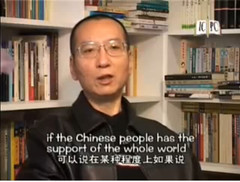
Quotes from Liu Xiaobo (5)

Immanuel Kant developed his own version of the...Image via Wikipedia
(From Mist of Metaphysics, Chapter 4: Kant - the Copernicus-like Revolution )
Religionizing Science is the most indiscernible and most dangerous (process?), but religionizing faith is the nature of life. The impact of Kant's idea - God had nothing to do with science - to modern philosophy is to remind us: never to religionize science and knowledge. In modern philosophy, Karl Popper's scientific philosophy -that is the denial of religionizing science - is much more important than Nietzsche's denial of God, because what Popper said was what we are capable to do, and what Nietzsche was not.
p215
(Kant) Fallacy originated from the pursue of absolute, ultimate or infinite by our reason, and the belief that this is achievable. This is what I said "mist of metaphysics" - the belief that our reason is capable of deciphering nature, unveiling the secret of life, deducing the existence of God, proving immortality of our soul. But all of these "capabilities" are delusional and fallacious. p226

The blind belief on fallacy is harmful, but not all harmful in terms of ethics. It brings infinite, unlimited and valuable hope to limited, transient and meaningless life. This "hope" can be both positive and negative: when it works as only a reference, it is positive; when it works as an absolute, it is negative. From this perspective, the losing "hope" of modern people is not really so hopeless, not really a collapse of everything, but just a destroy of those "absolute" - which worked as the only value of life, as a bound our hope. p226

No matter how dexterity and smart the Hegel's philosophy seems, overall, there's never been any philosophic systems as "obese" as Hegel's, never been any as "radiant" and "grand", and as stupid and pale. It indeed was a sparkling pyramid, but underneath, it didn't hold a seed of any life, but buried a putrid dead body. A tomb is a symbol of dead, no matter how grand it is. The wit of history is such: the true end of metaphysics was not marked by its sharpest opponent Kant, but by its most loyal follower - Hegel. p262
Enhanced by Zemanta

August 5, 2011

Van Gogh's Contribution

Paul Gauguin's ArmchairImage via WikipediaI love Van Gogh's works from the first time I saw them, but for long time I did not consider him as the "greatest" among "greatests", because I always put "traditional realistic skills" in my art criterion, even though I knew from beginning that technique was just part of art process. However, very recently I changed my mind. I finally freed myself from such conventional standard of art, and be able to look at Van Gogh from a fresh view. And from this view, I found he is simply the greatest ever.

The importance of Van Gogh's art, addition to its artistic value, I believe, also lies in its (art) historical value: it revealed a long buried truth - art can be created without traditional (realistic) techniques.

For many people the evaluation of a painting is all about technique, or the "likeness", or the "philosophy", but all of these were not Van Gogh's concern. In Van Gogh's painting, we do not see the so-called "profound thoughts" or "concepts", we do not see the passive simulation of nature, rather, we see strong colors, impulsive brush strokes, and the imaginations created by such elements. And these elements, by my opinion, are essence of art.

Once in his life Van Gogh tried to learn realistic skill, but he could not stand the boring process of training, so very soon he quit. He was then considered by his teacher Mauve (also his cousin) as having no potential in art. However Van Gogh did not give up art. He told his brother Theo in his letters that he clearly knew what he was doing and what he wanted, and did not need that much "techniques". What he did proved what he said - within 10 years, a very short period of time, he created massive amount of works with distinguished style, which we had never seen before.

There were several Van Gogh's contemporary artists (such as Gauguin and Rousseau) also reached high achievement without strong academic art training, but in my opinions, their realistic skills were all better than Van Gogh. I believe upon that time (late 19th century), Van Gogh was the only person who made such high level of creative art with the LEAST realistic art training.

This is Van Gogh's contribution - he simply destroyed academic tradition of art. He reached the "heart of art" without all those rational "rubbish". Face to face, heart to heart, Van Gogh made love with art by his "naked" communication with the nature. Starting from him, art gradually came back to its original form: emotional expressive, playful and intuitive, other than rational, thoughtful and technical, which had dominated western art tradition for thousands years. Of course, I should not say this change happened by Van Gogh's effort alone, but he certainly made the "loudest" impact on this crucial turn in art history.

Enhanced by Zemanta

August 4, 2011

Memoir at the Foot of Ngong Hill - Isak Dinesen's "Out Of Africa"

Ngong HillsImage by Mpigapicha via FlickrFirst I must say that this book is not for modern entertainment. It was a book Blixen wrote for herself. Only those who are interested in her "personally", or her unusual life experience, can be patient enough to finish the book.

Inside this book, Blixen recalled her life in Africa, when she had a farm at foot of Ngong Hills, Kenya. Very differently from the movie, she didn't mention any of her private life. She only had one sentence for her husband, and about Denys Finch Hatton, who was so important in the movie, Blixen only contributed about 40 pages (among whole 370 pages), in which we found no explicit description about they "love affair".

The opening pages about Africa highlands and Ngong Hills are simply brilliant. It's the best part of the book which I could read again and again (it reminds me the opening chapter of "Rebecca"). Soon after finishing "painting" this scenery, Blixen spent majority part of book to write about some native characters, such as her servants,cooks, etc. She also mentioned her white friends, who came to visit her and entertained her lonely time. Among these "entertainment" Denys Finch Hatton was the most important one.

Within about 40 pages, Blixen wrote about her "friendship" with Denys: their amazing Safaris, and their once almost daily amazing activity - flying over Africa Highlands. Even though she did not directly describe the true nature of their relationship, it is not hard for readers to see their intimacy. The death of Denys was plainly described, which shows me how tough Blixen was. She also wrote quite much details about choosing burying place for Denys, at the top of Ngong Hills, as Denys wished. The narration in the end of movie was exactly the same from the book, except the last sentence.

Denys Finch Hatton seemed to be an extraordinary figure. Among all his alleged "fine" qualities I admire his free and adventurous spirit the most. So I feel very happy for him that he was buried in a place that fits his will. He deserved this glorious land.

White people are not the main theme of this book. This book is all about native people. Native Africans seemed to be very fascinating to Blixen. They were so different from Europeans, but Blixen did not judge the differences by European stands (not even polygamy). Not only she respected their customs, but also their intelligence. In the movie, this view towards native was transmitted by Denys, but in book, this is Blixen's own philosophy - she admired native culture, found they had more advantages than Europeans in dealing with nature and life. They are many moving details about her relationship with native people, especially during her "hard time" - when she faced 'bankruptcy" and had to live the place she loved so dearly.

Karen Blixen Museum, Nairobi, KenyaImage via Wikipedia
Beside the natives, Blixen's true heroine of this book is African nature. Having been fancying Africa myself for long time, I found the best part of the book are those rich colored delineations of nature: lands, mountains, trees, clouds, sky, animals, and the best of all, the "air". Under her eyes, Africa was impersonated, and interacted with her mind like her confidant (even when she described her relationship with Denys, she used the nature as a metaphor). The book both starts and ends by Ngong Hills, a glorious "noble" mountain which can be seen from Blixen's house. Even though the whole book is not fictional, not chronological, but the real "protagonist"- Africa landscape puts all details together.

Yes, this book was written for Blixen herself, but it was also written for Africa, and for thsoe whoever love Africa and the Nature.


Enhanced by Zemanta

July 31, 2011

Quote from Liu Xiaobo (4)

Chinese Christmas gift: Dissident Liu Xiaobo S...Image by k-ideas via Flickr(From Mist of Metaphysics)
If the Crucifixion was the most shocking moment of Christianity, the thoughts of St. Augustine is the most unforgettable thoughts of Dark Age. The misery revealed by these two (persons) has been hunting human being until today. We must admit, this revelation is a brutal braveness, and a cruel awakening. (P116)

Discovering mysteries of nature by science was not only marked by several "natural principles" - in terms of anti-metaphysics - but changing human's belief. However, in modern history, the thinking style of human has not yet got rid of monism, hence scientism created a new God, new "metaphysics" - a rational, scientific myth. To destroy this myth, was the task of modern philosophy. (P124)

In the world there has never been "absolute lightness" and "absolute darkness". "Absolute" is the synonym of "hypocritical". (P124)

Having been broken the bound of religions and metaphysics, what human could do to conquer nature, develop life and get rid of the tragedy of human itself? This is the task of modern philosophy. In other words, a nature without the power of God, an individual without command of authority, how human could define himself? From this perspective, modern philosophy is not about God, nor about Nature, but Human himself. (P127)

There was a phenomenon, consisted of two contradictory attitudes - an objective empirical view toward the nature on one hand, a transcendantal or almost religious attitude toward the world on other hand - would co-exist within a single mind of a single philosopher... Maybe, human could never get rid of this dualism - swing back forth forever in between soberness and mystery. (P127)

Modern "philosophy of life" meant to destroy the rationalism which started from Socrate, Christianity and Hegelianism; "scientific philosophy" meant to destroy the empiricism from Bacon to Newton. So the anti-metaphysics is virtually anti-absolutism in many forms, ideas, "God", reason, experience, or science, whoever goes to absolute, whoever will receive challenge from anti-metaphysics. (P131)

In terms of thinking style, believing all knowledge must come from experience is the same as believing all knowledge must come from God. (P136)
Enhanced by Zemanta

July 18, 2011

Jean Valjean - A Gracious Soul Dwells In Darkness

CosetteImage via WikipediaA few days ago I finished reading "Les Miserables". Finally! Or I should say, I finished reading "Jean Valjean", because I jumped so many passages even the whole chapter of "Waterloo". I blamed my poor English reading skill for feeling difficulty in reading all pages of this book. However after I read instruction of the book I realized the digressions of this book seems to be an issue.

I must state openly that I do not usually enjoy the excessiveness on description, or writing endlessly on small details, so I cannot say this is my favorite book in terms of writing skill (even though I had read 4 Yuguo's other novels when I was in high school and highly enjoy every one of them), but, I must say, the story of this book - or story of Jean Valjean - deserves to be remembered as one of the greatest stories ever created, for the fact that it delves into such a depth of human nature: the greatest misery and greatest happiness a man/woman can ever experience and ever transcend. Also, the story was extremely beautifully done. Yugo indeed was one of greatest poets.

I like how Yugo named each part of the book: Fantine, Cossette, Jean Valjean, etc. Fantine is an icon of misery, Cossette an icon of happiness, Jean Valjean an icon of salvation, . The relationship between Valjean and Cossette is beautifully portrayed: the immense affection from Valjean and the unconditional trust from Cossette, both made the most innocent bound of two souls. Cossette's entering Jean Valjean's life is meant to be a gift from God, an Angel from Heaven. That's why when Valjean faces the "danger" of losing her, he feels the real peril of his life has just come - a peril greater than all of those he experienced before. That's how for the first time in his life Jean Valjean crys by himself.

Jean Valjean endured incredible hardship and injustice, yet he learned to pay back with the unconditional kindness. As the bishop pointed at the early stage of the story, if Valjean could surpass his past, turn himself into a new person who only love, he would be above all of other people. And that's what Jean Valjean turns out: a person who gives out kindness even though he has received and continues to receives injustice from society.

In this book we could see that human society and social system are full of injustice, which is so unfortunately true since so called "civilization" started. This is utmost unfair to people like Jean Valjean. However, it is author's belief that there is a greater justice: the judgement by God, which eventually handle reward or punishment. That's how Valjean never really tried to escape from Javert's chasing (Javert is an icon of unjust society); that's how at the end of book Javert commits suicide; that how Valjean has his final reward: true love from Cossette and Marius.

A friend (Nothingprofound) said this whole book is all about "forgiveness". I agree totally, even though I think Jean Valjean has done nothing that need to be forgiven. What he is punished by law are far away from crime, yet Yugo made him repent all the time because (I think) Yugo wanted to exaggerate the injustice. I don't really "buy" this sense of "sin", or "guilty", however I do appreciate and deeply moved by the sense of LOVE this book conveys: love melts hatred.

I also must state this, even though Jean Valjean constantly lived in repentance, constantly felt undeserved to Cossette's love, endlessly had that strong sense of looking for forgiveness, in my eye, unlike those filthy Thenardiers, his soul was always clean, he deserved every bit of happiness he found, and he was gracious from the very beginning.

I was big fan of Yugo whan I was young. I do not remember what was the reason I did not choose to read this book back then. After all these years, I am glad I finally read it. Les Miserables is legendary, regardless its "visible" flaws, and it is the most gracious "portrait" of the most gracious soul (Jean Valjean), though framed with the darkest color on this earth. Isn't true by this contrast, the "face" of Jean Valjean looks even more radiant?


-------------------------------------------------------------------------------------

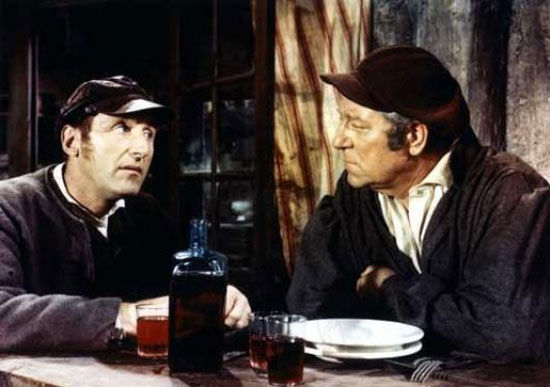
Jean Valjean (Jean Gabin) and Thenardier, 1958 French film directed by Jean-Paul Le Chanois.


P.S. After finishing reading, I watched 3 movies: 1958 French version (which I watched almost 30 years ago but understood/remembered nothing) with Jean Gabin as Jean Valjean; 1998 version with Liam Neeson; 1935 with Fredrich March. I enjoyed the 1958 version the most. Jean Gabin is almsot a perfect Jean Valjean, except his build is a little small. I also enjoy 1935 version, but I think Fredrich looks too polished for Jean Valjean. I cannot stand the 1998 version especially the end: Jean Valjean smiled after Javert died. I don't think Yugo would prove that idea.

Enhanced by Zemanta

July 17, 2011

Generality vs. Particularity

United States, Colorado, United States Olympic...Image by iceman9294 via FlickrRecognizing generality from complexity of a group (people or nature phenomenons) is a result of acute observation, intuition and reasoning; however, applying such generality to every individual of group is an act of prejudice. The reason is simple: while each group of people (or natural matters) has their generality, each individual of group also has its own particularity which cannot be summarized by the generality of its group. Simply categorizing people into different groups (races, religions, sexes, sexual orientation, etc.) and treating each individual by generality of his/her group, seems to be one of major ignorances of human and the primary cause of segregation (separation?) among different groups of people.
Enhanced by Zemanta

June 21, 2011

Two Things Are Infinite

"Only two things are infinite, the universe and human stupidity, and I'm not sure about the former."
-- Albert Einstein

June 20, 2011

Quote from "Shawshank Redemption"

When "Andy" plays "Marriage of Figaro", narration by "Red" (Morgan Freeman):
"I have no idea to this day what those two Italian ladies were singing about. Truth is, I don't want to know. Some things are best left unsaid. I'd like to think they were singing about something so beautiful, it can't be expressed in words, and makes your heart ache because of it. I tell you, those voices soared higher and farther than anybody in a gray place dares to dream. It was like some beautiful bird flapped into our drab little cage and made those walls dissolve away, and for the briefest of moments, every last man in Shawshank felt free."

June 15, 2011

Four Attitudes About UNKNOWN

Telescope and night skyImage via Wikipedia
"Who are we? Where do we come from? Where are we going?" After several thousands years of civilization, the question remains as the same as beginning: we still face that mysterious world of UNKNOWN.
Probably, the attitudes (driven by different thinking styles) toward this UNKNOWN divide us in different types of people: rational, irrational, superstitious, skeptical, or something else. Below is what I could think of now about four different attitudes toward this UNKNOWN.

1. To understand the existence of UNKNOWN and accept it, to admit there is a immense part of Universe that is beyond our current (or even future) understanding, to suppose we human may or may not eventually understand this Universe, is an attitude of rationality;


2. To irrationally affirm the "knowledge" of UNKNOWN, to factualize UNKNOWN, to mystify or decorate UNKNOWN as human wishes, is an attitude of religion, or "conventional" superstition;

3. To hold our reason firmly as a solution to everything, to deny the existence of UNKNOWN, or to believe that just because we have known a great deal so we will know everything sooner of later, is an attitude of modern "religion" - worship of science;

4. To absolutely deny any possibilities to reach the truth of "UNKNOWN", to disbelieve completely about science in terms of discovering the truth of universe, is an attitude of agnosticism, which is also irrational, because it kills "HOPE" (or possibility) - the only thing that perhaps will be always "alive" (as long as the Universe exists).

June 14, 2011

Two Conditions That Produce Life Misery

The Pacific OceanImage via Wikipedia
If we agree that being able to be ourselves is the most essential condition of our life happiness, two other conditions will destroy this condition:

1: Trying to be someone else other than ourselves.
This "ambition" is built on illusion - "someones else" are mistaken for "ourselves". The causes of such illusion are multiple and complicated, but I believe a very important cause is false parenting/education.
When we held this "illusion", life is inevitably on the route towards misery, because (at the best account) even if we succeeded this "ambition" at certain level - i.e. we successfully turned out to be "someone else" - we could still not be truly happy because our true nature (or true "selves") will always be hungry at our unconscious level.
The only way to change this condition is "enlightenment" - realizing we are on the wrong track. As soon as we reach this enlightenment, happiness will naturally emerge to our life.
However, the danger of this condition is, if the condition stays too long with us, (also depend on how strong our "true selves" and "other selves" are) we might eventually forgot who we truly are, hence it is almost impossible to get our "true selves" back.

2. Knowing who we are but could not become who we are.
This condition is also created by complicated and multiple factors: false parenting/education, physical diseases, wars, social systems, or ultimately, fate.
I found this is the most commonly struggled condition of life. The ways to cope with such condition are numerous and complicated, and there will never be a single universal solution to this problem, because no one has the completely same life course as others, . However, to simplify the tanglement I would say there are two major pathways to get out of trap: fight and acceptance*.
If there is one thing worth fighting for in this world, it would be "happiness". However sometime the "enemy" can be some unconquerable monsters, such as powerful side of our relationship, or powerful social classes, or even "fate"; sometime the fighters -"we" - can be too fragile to fight, either mentally or physically, such as individuals against groups, fatal diseases, etc. In such cases, negotiation, or acceptance need to take place.
So after all, I think wisdom lies in the balance between "fighting" and "acceptance" - those who know when to fight and when to negotiate will eventually win the happiness, no matter what condition is.
However, since happiness is worth fighting for, I would say:

(If we really know what we want) Never negotiate without a fight.


*I have used "negotiation" and "acceptance alternatively, but I do know they do not have identical definition. The difference between them would be a relatively serious topic in which I do not wish to evolve.

Enhanced by Zemanta

June 13, 2011

Ellen Degeneres - A True Genius of Love

If people asked me who was my favorite actors or actress, I might not have an immediate answer, but if people asked am who was my favorite comedian, my answer would be straight and simple: Ellen Degeneres.

I was so impressed by her early stand up shows (I even ran for a live one in Northampton, Mass). All her early stand up shows were incredibly hilarious and philosophic! Reminding me lot of Taoist ideas about life. She was the first American person (I know of) I consider as a Taoist.

The first stand up show I watched was "New Beginning" - the show she performed on her first tour after she came out from her "down time" (her hollywood career was destroyed by her coming out in 90s). I watched this show on VHS type. Now it's on youtube:


It is a true inspiring piece about life.

Later, her new stand up show "Here and Now" came out:


"Here and Now" is all about the "boring" "procrastination", but by my opinion this is a true masterpiece of Taoism about time and life. I highly recommand who ever interested in Taoism and Ellen as a genius thinker (she actually only had high school diploma) watch these brilliant comedy stand up. You will not be disappointed!

June 11, 2011

Quotes from "Les Miserables"


Innocence wears its own crown, Monsieur; it needs no added dignity; it is as sublime in rags as in royal robes. p54

...since natures vary, we must agree that all the beauties of human excellence may be fostered by faiths that we do not share. p65

What more could he need, this old man whose little leisure was divided between daytime gardening and night-time contemplation? Was not that narrow space with the sky its ceiling room enough for worship God in the most delicate of His works and in the most sublime? A garden to walk in and immensity to dream in - what more could be ask? A few flowers at his feet and above him the stars. p68

Man is so constituted that he can endure long periods of suffering, both moral and physical, without dying of it. p96

Curiosity is a form of gluttony: to see is to devour. p183

There is a prospect greater than the sea, and it is the sky; there is a prospect greater than sky, and it is the human soul. p208

June 10, 2011

Spiritual Reality - Journey Within

A friend of mine sent me this video presentation about Buddhist concepts such as Meditation, Knowledge, Energy, Consciousness, Life and Death, etc.
Not sure how superstitious you would find, I found it both inspiring and superstitious. Several interesting quotes from video:

Sleep is an unconscious meditation; meditation is conscious sleep;
Meditation is nothing but a journey of our Consciousness toward "self";
Knowledge is nothing but experience;
Consciousness is a combination of Energy and Knowledge.


May 28, 2011

About "Social Differentiation"

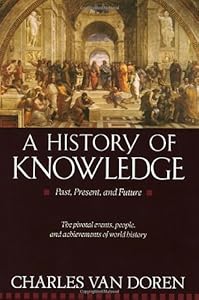
Cover of "A History of Knowledge: Past, P...It is everywhere true that those at the bottom of the social hierarchy are the majority. ...Why then does the majority remain deprived? The minority at the top may have a near monopoly of force, but force alone is not the answer. A system of social differentiation must be found in which all believe, not just some.

---Charles Van Doren: A History of Knowledge
Enhanced by Zemanta

May 26, 2011

Jack Nicholson and His Movies

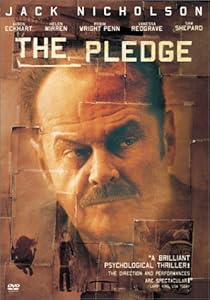
Cover of "The Pledge"Cover of The PledgeJack Nicholson has been always one of my favorite actors. After watching three his movies in a raw, now I must say I am a huge fan of his. His acting is superb!

"About Schmidt", "The Bucket List" and "Pledge"(2001) are what I have watched recently. I absolutely love everyone of them, however, I would especially mention "Pledge", an unusual mystery directed by Sean Penn. The story is based on a novella written by a Swiss writer. This is not an usual mystery with fast paced story line, but rather a slow paced and drama-like movie, yet highly suspenseful, with an end that is unexpected, pitiful, and eventually thought provoking.

For me, this movie not only depicts an obsession of a detective to his promise, but also reveals a truth of life, which I personally more and more believe: real truth is often beyond our "masterful" hands. We are helpless on this fact.
Well, does this mean we better live in illusion? I don't know, but it might be.
Enhanced by Zemanta

May 25, 2011

"If I Know A Song Of Africa"


"If I know a song of Africa, of the giraffe and the African new moon lying on her back, of the plows in the fields and the sweaty faces of the coffee pickers, does Africa know a song of me? Will the air over the plain quiver with a color that I have had on, or the children invent a game in which my name is, or the full moon throw a shadow over the gravel of the drive that was like me, or will the eagles of the Ngong Hills look out for me?"
— Karen Blixen ("Out of Africa", 1985 film)

May 24, 2011

"Evidence"

Behind the EvidenceImage via WikipediaEvidence: the "facts" that support our beliefs.

As soon as people's minds are settled with some belief systems, all existing facts become "evidences" to validate/consolidate those beliefs. The facts that disprove their beliefs are either nonexistent or, simply invisible.
So, it is almost impossible to change people's mind by presenting "evidences".
Enhanced by Zemanta

May 23, 2011

Quotes for "The Bucket List" (Film, 2007)

Film poster for The Bucket List - Copyright 20...Image via WikipediaCharter Chambers: (My pastor always says) our lives are streams flowing into the same river towards whatever heaven lies in the mist beyond the falls. Find the joy in your life, Edward. My dear friend, close your eyes and let the waters take you home.

Edward Cole: Carter and I saw the world together, which is amazing when you think that only three months ago we were complete strangers. I hope that it doesn't sound selfish of me, but the last months of his life were the best months of mine. He saved my life, and he knew it before I did. I'm deeply proud that this man found it worth his while to know me. In the end, I think it's safe to say that we brought some joy to one another's lives, so one day, when I go to some final resting place, if I happen to wake up next to a certain wall with a gate, I hope that Carter's there to vouch for me and show me the ropes on the other side.


Enhanced by Zemanta

May 14, 2011

Out of Africa - Journey of Man

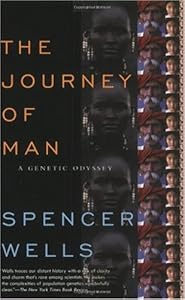
Cover of "The Journey of Man: A Genetic O...Cover of The Journey of Man: A Genetic OdysseyThe origin of human: where did we come from, is certainly one of the most important/enchanting questions of history. Recently I watched a series of documentary videos and one of them seemed to have unraveled this riddle, at least to a certain extent.

It seems to me, that the "theory" of all people on this earth originated from Africa is not a foreign to most of us, but I did not know that up to date, scientists already have concrete evidences, such as DNA, to prove this "theory". Journey of Man: A Genetic Odyssey, a documentary movie based on book with the same name (published in 2002. How behind I am!) written by Spencer Wells (an archeologist and geneticist), has advanced investigation on this subject. After his comprehensive researches Wells reached an absolutely certain conclusion with (DNA) evidences that we human, all came from Africa.
No wonder I have such fascination with Africa!

Thank Wells for the brilliant job. I am not a professional historian but I consider this finding a milestone in history study.

Of course, still, this discovery only reveals our physical origin, that much more mysterious question - where is our "spirit" (I am not satisfied with biological answer such as "brain function") come from - is still out there.

May 13, 2011

Crop Circles - Art of mystery


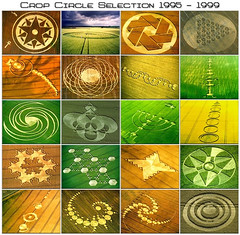
Crop Circles 1995-1999Image by frankdasilva via FlickrLong time ago I watched TV news about crop circle hoax. Since then I never bothered again with this "phenomenon". I do not remember details of this news but roughly recall two men were busy working in the field under moonlight. Just recently I "accidentally" watched some videos about this subject from youtube. This time, I was absolutely stunned by the beauty of these amazing "formations".


By my spontaneous nature I immediately dove into some mysterious causes of these beautiful "creatures". One of documentaries from youtube was especially fascinating - it tells that one of crop circles was obviously responding to the (binary?) message that NASA sent to out space over 20 years ago (Crop Circles Decoded?). Beside such kind of amazing ideas, the perfect geometries, the precise design and the allegedly short time of their appearance, really overwhelm me. And I cannot help to wonder, how could people on this earth stay so calm?

It proves it is not so hard to stay calm. After I did some "researches", my attitude started leaning to another side: they are all man-made. I cannot say I am 100% convinced, but most likely the chance of being otherwise is slim.

There are also many "scientific" facts about these formations have been claimed by many "experts", such as energy changed, or "the composition of soil was completely changed"*, etc. I am not a scientist so I cannot disprove those claims.

One thing I am quite certain about is, these formations are not designed by people who are solely "artistic", nor by some simple/playful motive, but with extremely good artistic taste and high intelligence, because all these formations show incredible design sense, and all of them (for what I saw on internet) made with incredibly geometrical precision. Personally I don't not believe they were made by random amateurs. But how did this technique and unique design talent spread over the world, is simply a mystery to me.

It was said the creators of crop circles have never claimed authorship because they want to "sustain the mystery"*. Based on the article "Crop Circle Conundrum"*, one of experts said:
"In our culture, art is all to do with artists: it’s about whodunit, not about what art does. With the circles, it’s about the effect they have on people." This certainly makes a good point but I am not convinced that this is the reason they stay in hidden. But if it is, I am sure they are having great fun.


Enhanced by Zemanta